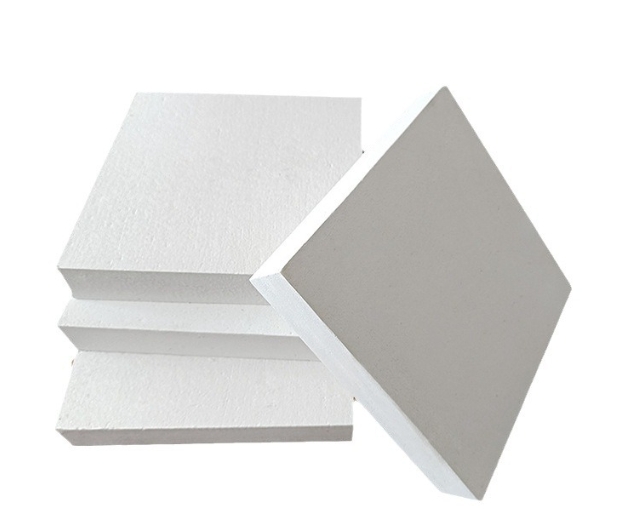
Lightweight refractory insulation materials, such as ceramic fibre boards and ceramic fibre blankets, are commonly used in the linings of high-temperature industrial furnaces. However, it has been observed that after prolonged use, materials such as ceramic fibre boards may shrink, experience fibre shedding or even become damaged. So, what causes the shrinkage and fibre shedding of ceramic fibre boards?
Zirconia-containing ceramic fibres are all classified as vitreous ceramic fibres, which are prone to shrinkage when subjected to high temperatures over extended periods. This is determined by the inherent properties of the ceramic fibre material itself. At the microscopic level, this is caused by crystallisation and grain growth occurring in vitreous ceramic fibres at high temperatures. Glass is formed by the rapid cooling of a molten mass. This state is not the lowest energy state; it possesses higher internal energy than a crystalline state and is therefore a metastable state.
From a thermodynamic perspective, it has a tendency to spontaneously transform into a lower-energy state; the atoms automatically rearrange themselves, meaning there is a tendency towards crystallisation and a transition to a crystalline state.
From a kinetic perspective, as vitreous materials have high viscosity at room temperature, the rates of internal atomic diffusion and rearrangement are low. Consequently, the rate of transition from the vitreous to the crystalline state is extremely slow, giving it considerable relative stability at room temperature; it is, therefore, also a stable state.
Glass-state ceramic fibres are characterised by short-range order and long-range disorder. As the temperature rises, the viscosity of the fibres decreases, atomic motion intensifies, and the rates of atomic diffusion and regularised arrangement increase; the long-range disorder transitions towards an ordered arrangement, i.e. crystallisation. The spacing between ordered, regular arrangements decreases, leading to volumetric contraction of individual ceramic fibre strands. Under prolonged exposure to high temperatures, the formed crystals grow larger, causing the surface of the ceramic fibre strands to become uneven—a phenomenon known as diameter reduction. Continuous diameter reduction results in a shortening of the ceramic fibres, thereby causing overall contraction.
Once macroscopic shrinkage has occurred, the ceramic fibre board lining will crack and develop gaps under prolonged exposure to the flame atmosphere. Once these gaps appear, the flame and gas flow take the opportunity to penetrate them, causing the ceramic fibres on either side of the gap to come into direct contact with the flame and gas flow, thereby becoming active areas. As time elapses, the ceramic fibres at the contact surface continue to shrink and expand perpendicular to the contact surface, causing the gaps to widen progressively. Consequently, increasing amounts of flame and gas flow will penetrate the gaps, spreading continuously in all directions. Upon contact with the anchoring pins securing the ceramic fibre boards, these pins will oxidise and corrode under prolonged exposure to high-temperature gas flow, eventually fracturing and causing the ceramic fibre boards to shatter and detach. At the same time, the backing of the ceramic fibre blanket also shrinks and crumbles, eventually fracturing and falling away; in severe cases, this can lead to the complete failure and detachment of the entire ceramic fibre furnace lining.
Therefore, to ensure that such phenomena are prevented, when selecting products such as ceramic fibre boards, it is essential to choose them based on the furnace’s operating temperature and the highest instantaneous temperature that may be reached. Under no circumstances should they be used at temperatures exceeding their specifications, as this will accelerate the shrinkage and detachment of the fibres. It is also necessary to regularly inspect the condition of the ceramic fibre board lining. Should significant shrinkage or leaks occur, repairs must be carried out promptly. For minor gaps, loose ceramic fibre batt can be used to fill them; in more severe cases, the damaged ceramic fibre boards must be replaced. This will help to extend the service life of the ceramic fibre board lining.