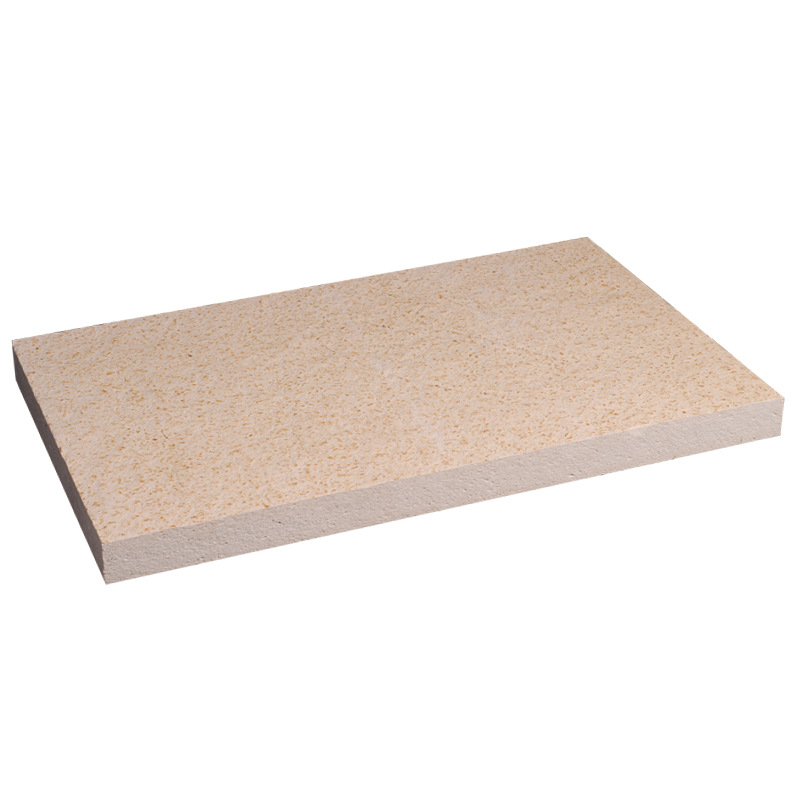
Whilst traditional ceramic fibre boards begin to soften and deform at 1400°C, zirconia-doped ceramic fibre boards (ZrO₂-CFP) remain structurally stable at temperatures of 1600°C. This technological breakthrough is reshaping the standards for material selection in fields such as ultra-high-temperature kilns, thermal protection systems and molten metal transport. Today, Mu Yi will provide an in-depth analysis of the mechanism of action, preparation processes and industrial applications of zirconia-doped ceramic fibre boards.
I. A Revolution in Materials Science: The ‘Magic of Phase Transitions’ in Zirconia
1.1 The Crystalline Mysteries of Zirconia
Zirconia (ZrO₂) exists in three crystalline forms:
Monoclinic phase (m-ZrO₂): Stable at room temperature, but prone to cracking at high temperatures
Tetragonal phase (t-ZrO₂): A metastable state at high temperatures, undergoing a reversible phase transformation at 1170°C
Cubic phase (c-ZrO₂): A stable state at high temperatures, requiring doping with stabilisers (such as Y₂O₃ or CeO₂)
Toughening mechanism via phase transformation:
As a crack propagates, the tetragonal phase of zirconia undergoes a martensitic phase transformation (t→m), resulting in a volume expansion of 3–5 per cent. This generates compressive stress on the crack, increasing the fracture energy by 2–3 orders of magnitude.
1.2 Core Technologies of the Doping Process
Nanoscale dispersion: The sol–gel method is employed to achieve a uniform distribution of zirconia particles ranging from 5 to 20 nm
Gradient doping: The surface layer is enriched with 8YSZ (8% yttrium-stabilised zirconia), whilst the core layer utilises pure Al₂O₃ fibres
Interface optimisation: SiC whiskers are introduced as bridging agents to enhance the bonding strength between the matrix and the zirconia particles
II. Experimental Data on Limit Properties
2.1 High-Temperature Stability Testing
Thermogravimetric Analysis (TGA):
Undoped sample: 12% weight loss at 1450°C (lattice collapse)
Doped sample: <1% weight loss at 1600°C
Creep resistance:
Deformation <0.3% after 100 hours at 1500°C/0.5 MPa
2.2 Thermal shock cycling test
Water quenching method:
Rapid cooling from 1600℃ to room temperature; no cracking observed after 50 cycles
Comparison with standard ceramic fibre boards: failure occurred after just 3 cycles
2.3 Corrosion Resistance
Molten aluminium test:
Mass loss < 0.1% after 72 hours’ immersion in molten aluminium at 1200℃
Scanning electron microscopy (SEM) revealed the formation of an Al₂O₃-ZrO₂ composite protective film on the surface
III. Analysis of Four Major Industrial Application Scenarios
Scenario 1: Ultra-high-temperature kiln linings
Challenge: Kilns operating at 1700°C require zero-maintenance operation for >1000 hours
Solution:
Multi-layer composite structure:
Inner layer: ZrO₂-CFP (thickness 30 mm)
Middle layer: Corundum-mullite bricks
Outer layer: Lightweight ceramic fibre felt
Measured results: Kiln service life increased by 400%
Scenario 2: Rocket Exhaust Flame Thermal Protection
Requirement: Withstand instantaneous temperatures of 2800°C (for 30 seconds)
Innovative Application:
ZrO₂-CFP/C composite layer:
Carbon fibre reinforcement provides erosion resistance
Zirconia coating facilitates radiative heat dissipation
Simulation Testing: No delamination observed after 5 thermal shock cycles
Scenario 3: Molten Platinum Conveyance Piping
Operating Conditions: 1900°C liquid platinum/high-pressure hydrogen environment
Material Optimisation:
ZrO₂-CFP+Pt coating:
The zirconia layer provides thermal stability
The platinum coating prevents metal permeation
Leakage rate: <0.001 g/year (helium mass spectrometry detection)
Scenario 4: D-wall of a nuclear fusion reactor
Extreme Conditions: