As energy densities in new energy vehicles and energy storage batteries continue to break new ground, battery thermal management has become a key bottleneck affecting safety and service life. as a new type of thermal insulation material, is demonstrating revolutionary application potential in power battery packs. Today, Mu Yi will provide an in-depth analysis of its technical characteristics, performance advantages and industrial value.
I. Technical Breakthroughs in Ceramic Fibre Paper: From Aerospace Materials to Battery Thermal Insulation
Ceramic fibre paper is manufactured from aluminium oxide and silicon dioxide fibres using a wet-forming process, and offers three core advantages:
Ultra-thin structure: Thickness can be controlled between 0.1 and 2 mm (compared to traditional aerogel spacers, which are >3 mm);
Extreme high-temperature resistance: Long-term operating temperature >1,200 °C; short-term resistance up to 1,600 °C;
Ultra-low thermal conductivity: thermal conductivity of 0.02–0.05 W/m·K, superior to that of mica sheets (0.08 W/m·K).
Its unique three-dimensional mesh structure not only suppresses heat conduction but also maintains excellent flexibility, allowing it to be cut and processed just like ordinary paper.
II. Addressing the Four Major Pain Points in Battery Thermal Insulation
1. Low space utilisation
Traditional thermal insulation materials (such as aerogel felt and mica sheets) are thick, thereby reducing the space available for battery cells. Ceramic fibre paper is less than 0.5 mm thick, increasing the volumetric energy density of battery packs by 3–5 per cent.
2. Risk of thermal runaway
Needle-puncture tests show that battery cells insulated with ceramic fibre paper experience a 40 per cent reduction in heat propagation rate, with the time to thermal runaway extended by more than twofold.
3. Demand for Lightweight Solutions
With a density of just 0.2–0.5 g/cm³, it reduces weight by 60–70 per cent compared to traditional materials, thereby increasing the vehicle’s overall range.
4. Cost Sensitivity
Following large-scale production, costs are 40–50 per cent lower than those of imported aerogel materials, making it suitable for mass manufacturing requirements.
III. Innovative Application Scenarios: From Cells to Modules
1. Thermal Isolation Between Cells
Prismatic batteries: Wraps around the tab area to prevent localised overheating from triggering a chain reaction;
Cylindrical batteries: Acts as an outer thermal insulation layer for the wound core, improving space utilisation.
2. Module Structural Reinforcement
Composite thermal insulation panels: Ceramic fibre paper combined with an aluminium alloy substrate, balancing heat dissipation and insulation;
Liquid-cooling channel isolation: Prevents direct contact between coolant and battery cells, enhancing system safety.
3. Applications in Special Scenarios
Fast-charging scenarios: Suppresses temperature rise, supporting 800V high-voltage fast-charging technology;
Low-temperature environments: Reduces heat loss, improving range performance in winter.
IV. Performance Comparison and Technical-Economic Analysis
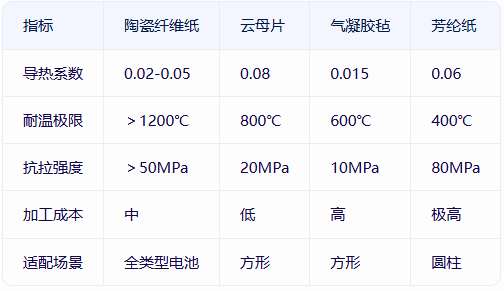
Economic Analysis:
Taking a square battery module as an example, adopting the ceramic fibre paper solution increases the cost per module by approximately 80 yuan; however, by improving energy density and safety, the overall cost-benefit ratio is enhanced by a factor of 2.3.
V. Industry Trends and Technological Iteration
1. Material Compositing
Ceramic + PI film: Enhances resistance to electrolyte corrosion;
Vacuum aluminium coating: Adds radiant heat reflection functionality.
2. Functionalisation of Structures
Embedded sensors: Enable real-time temperature monitoring;
Self-healing coatings: Automatically repair micro-cracks, extending service life.
3. Standardisation
GB/T 3811-2023 ‘Safety Requirements for Lithium-ion Power Batteries for Electric Vehicles’ has specified that thermal insulation materials must pass a 1,300°C thermal shock test, making ceramic fibre paper one of the essential solutions.
Conclusion: The ‘Paper’ Revolution in Battery Safety
The emergence of ceramic fibre paper has not only redefined the performance boundaries of battery thermal insulation but has also driven the development of lighter, more integrated thermal management systems. With the mass production of new technologies such as 4680 large cylindrical batteries and solid-state batteries, its range of applications will continue to expand. For battery manufacturers striving for the highest levels of safety and energy efficiency, mastering this material technology means securing a first-mover advantage in the competition for next-generation batteries.