Against the backdrop of accelerating efforts to achieve carbon neutrality in the industrial sector, technological breakthroughs in energy-saving materials have become a key driver for companies to reduce costs and improve efficiency. Thanks to its superior physical structure and material properties, ceramic fiber blanket demonstrates significant advantages in high-temperature thermal insulation, offering energy savings of up to 40% compared to traditional materials. As a result, it has become the preferred insulation solution in industries such as aerospace, petrochemicals, metallurgy, and power generation.
I. Three-Dimensional Insulation Mechanism: Overcoming the Efficiency Limitations of Traditional Materials
Traditional insulation materials, such as rock wool and glass wool, primarily rely on a single mechanism of thermal conduction blocking. In high-temperature environments, their performance tends to degrade due to heat loss via convection and radiation. In contrast, ceramic fiber blankets utilize a dual-effect design combining an interwoven fiber structure with a composite layer of aluminum foil to create a three-dimensional insulation system:
Conduction Barrier: Ceramic fiber blankets utilize alumina-silica fibers with diameters of 3–5 μm, which are processed through a double-sided needling technique to form a highly porous (≥95%) structure. The stationary air pockets between the fibers form an “air pressure barrier layer,” extending the heat conduction path by 3–5 times. At 1000°C, the thermal conductivity is as low as 0.22 W/(m·K), which is only one-sixth that of refractory bricks.
Convection Suppression: The dense network formed by interwoven fibers effectively impedes gas flow. Combined with the surface density of the aluminum foil layer, this reduces convective heat loss to one-third that of traditional materials. Actual measurement data from Shandong Luyang Co., Ltd. shows that when its aluminum-foil-coated ceramic fiber blanket is used in steam pipelines, surface temperature fluctuations are reduced by 15°C compared to ordinary materials.
Radiation Reflection: The aluminum foil layer achieves a reflectance of 90% for infrared radiation in the 1.8–6.0 μm wavelength range. Combined with the ceramic fiber’s own radiation absorption coefficient of 0.3–0.5, this creates a dynamic thermal insulation cycle of “reflection–absorption–re-reflection.” The three-layer ceramic fiber blanket structure used in the NASA Parker Solar Probe’s coronal protection system successfully maintains the probe’s surface temperature below 300°C.
II. Material Modification Technology: Breakthroughs in High-Temperature Applications
To address high-temperature scenarios, the research team achieved a quantum leap in material performance through nano-doping technology:
Silicon Carbide Nanowire Reinforcement: By introducing 5% silicon carbide nanowires into the fiber matrix, the “grain boundary strengthening-phase transformation toughening” mechanism increases the material’s tensile strength at 2,800°C to three times that of conventional materials, while reducing thermal conductivity by 40%. The SiO₂-Al₂O₃-ZrO₂ ternary gradient fiber developed by Donghua University reduces thermal conductivity at 1,000°C to 0.018 W/(m·K), approaching aerogel levels.
Functional Gradient Design: To address thermal shock scenarios during aerospace re-entry, a density-graded structure was adopted: the leading edge uses a 0.35 g/cm³ AETB-16 fiber blanket capable of withstanding over 20 thermal shocks, while the trailing edge employs a 0.15 g/cm³ flexible woven fabric to achieve integrated thermal protection and insulation. After applying this technology to the X-37B orbital vehicle, the overall weight was reduced by 40%, and the payload capacity increased by 15%.
Smart Responsive Coating: The Zr-Ti-C-B quaternary coating developed by Central South University remains stable under heat flux impacts of 3,000°C and is applied to the protective skirt of the Long March 5 rocket. This coating adjusts surface thermal radiation characteristics through dynamic phase transitions, improving thermal insulation efficiency by 25%.
III. Full Lifecycle Energy Efficiency: A Green Closed-Loop from Production to Recycling
The energy-saving advantages of ceramic fiber blankets extend throughout the material’s entire lifecycle:
Reduced production energy consumption: Bio-based raw material substitution technology uses straw and sugarcane bagasse to extract silica-alumina sol, reducing carbon emissions by 40% compared to traditional bauxite processes. Laser ultrasonic inspection technology developed by Boeing and NASA reduces energy consumption for quality control by 60%.
Improved Construction Efficiency: Sales of modular prefabricated products are growing at an annual rate of 13.7%, and their standardized design reduces installation time by 70%. Taking the retrofit of a 1,000 m³ petrochemical cracking furnace as an example, the use of ceramic fiber modules shortened the construction cycle from 45 days to 12 days compared to traditional refractory brick construction, while reducing fuel consumption by 30%.
Recycling System: The developed ceramic fiber recycling process melts waste blankets at 1,600°C to reform them into fibers, achieving a recovery rate exceeding 50%. Each ton of recycled fiber reduces CO₂ emissions by 1.2 tons and lowers costs by 18% compared to virgin materials.
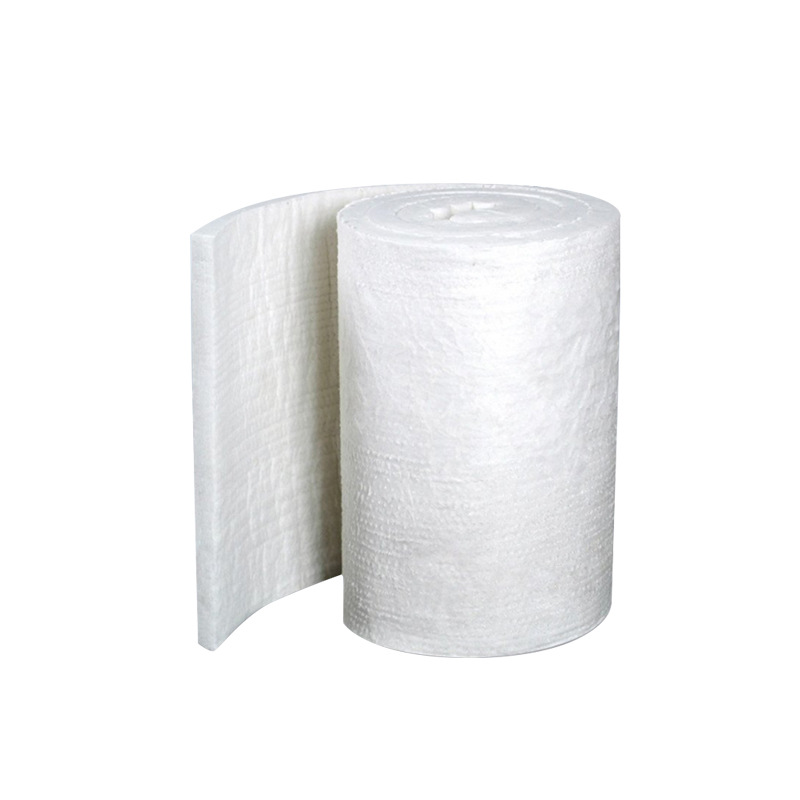 Ceramic fiber blanket
IV. Industry Application Case Studies: Quantifying Energy-Saving Benefits
Power Industry: After installing ceramic fiber blankets in the boiler of a 600 MW supercritical power unit, flue gas temperature dropped from 145°C to 128°C, coal consumption decreased by 1.8 g/kWh, and annual standard coal savings reached 12,000 metric tons.
Petrochemical Sector: During the retrofit of an ethylene cracker at Sinopec Zhenhai Refining & Chemical, ceramic fiber modules reduced furnace wall temperatures from 260°C to 85°C, cutting fuel gas consumption by 8% and reducing annual CO₂ emissions by 42,000 metric tons.
Aerospace: The thermal protection system of SpaceX’s Starship utilizes ceramic fiber composites, achieving a 35% weight reduction compared to traditional phenolic resin solutions and improving surface temperature control accuracy by 40% during atmospheric re-entry.
V. Directions for Technological Iteration: Defining Next-Generation Thermal Insulation Standards
Currently, ceramic fiber blanket technology is advancing in three key areas:
High-Temperature Materials: Developing zirconate fibers capable of withstanding 3,000°C to meet the requirements for D-wall materials in nuclear fusion devices.
Smart Responsive Materials: Embedding temperature-sensitive shape-memory alloys to enable dynamic adjustment of thermal insulation performance.
Nanocomposites: Reducing thermal conductivity to below 0.01 W/(m·K) through graphene doping, challenging the dominance of aerogels.
Against the backdrop of the energy transition, ceramic fiber blankets are reshaping the market landscape for high-temperature insulation materials thanks to three core advantages: a three-dimensional thermal insulation mechanism, nanomodification technology, and energy savings across the entire lifecycle. As the “dual carbon” goals are further advanced, technological advancements in this material will continue to drive energy efficiency upgrades in the industrial sector and provide critical technical support for human exploration of high-temperature and high-heat environments.