Against the backdrop of a restructuring global steel industry, India is rapidly rising to become the world’s second-largest steel producer, with crude steel output growing at an annual rate of 5% to 11%. In the 2024–2025 fiscal year, India’s crude steel output exceeded 146 million tons, while steel imports hit a nine-year high of 10.63 million tons. Behind these figures, a notable industry trend—a 300% year-over-year surge in China’s exports of ceramic fiber blankets—has drawn significant market attention. This demand-driven trade shift is reshaping the global supply chain for high-temperature industrial materials.
I. Steel Capacity Expansion Fuels a Hundred-Billion-Yuan Insulation Materials Market
The expansion plans of the Steel Authority of India Limited (SAIL) and Tata Steel confirm the industry’s explosive growth. The former operates 15 iron ore mines with an annual production capacity of 33.78 million tons, while the latter plans to increase its mining capacity from 40 million tons to 55 million tons. Even more noteworthy is that the National Mineral Development Corporation (NMDC) plans to expand its iron ore production capacity from 45 million tons to 100 million tons by 2030. The Nagarnar Steel Plant, which serves the NMDC’s Baira Dila mining area, has already established an annual molten iron production capacity of 3.321 million tons.
This surge in production capacity is directly driving up demand for thermal insulation materials. Taking the ultra-low emission retrofits in the steel industry as an example, each existing furnace retrofit requires ceramic fiber lining materials worth over 12 million yuan. In the field of photovoltaic polysilicon reduction furnaces, a single gigawatt (GW) of installed capacity corresponds to 180 tons of ceramic fiber demand, with the market size expected to exceed 900 million yuan by 2030. The explosive growth of the new energy vehicle industry has brought about even more disruptive changes—after power battery packs adopted a 1mm-thick ceramic fiber aerogel composite layer, the thermal runaway escape time was extended to 30 minutes, driving the demand for related materials to triple within five years.
II. China’s Materials Industry Breaks Through Technical Barriers to Achieve Import Substitution
In response to the Indian market’s urgent demand for high-end thermal insulation materials, Chinese enterprises have achieved key breakthroughs in R&D. Mu Yi’s zirconia-containing fiber products, which can operate at temperatures 200°C higher than traditional materials, have successfully penetrated India’s high-end steel market. Even more notable is the industrial application of mechanically adaptive ceramic fiber aerogel. After being exposed to a 1,200°C flame for 120 seconds, the temperature on the reverse side of this material was only 143.5°C—300°C lower than that of Indian domestic products—while maintaining a tensile strength of 170.38 MPa.
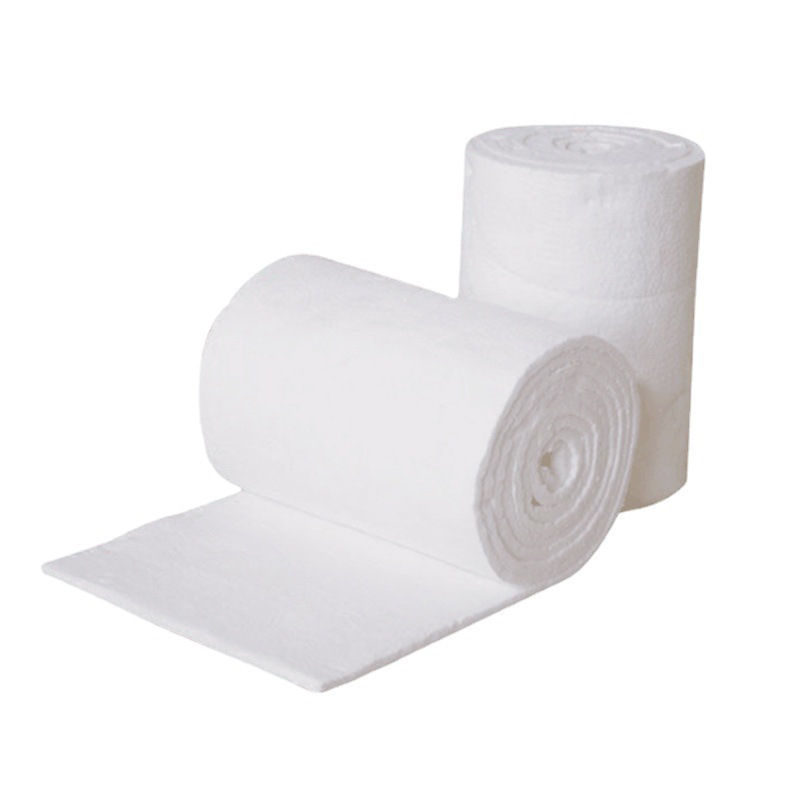
This technological advantage is directly reflected in trade data. In the first half of 2025, China’s exports of ceramic fiber blankets to India reached 2.83 million tons, accounting for 27% of India’s total imports and tying with South Korea for first place. Particularly in the electrical steel sector, China’s exports of cold-rolled grain-oriented silicon steel (CRGO) filled 30% of India’s supply gap, and its 0.18mm ultra-thin products reduced transformer energy consumption by 15%.
III. Opportunities for Supply Chain Restructuring Amid Tariff Negotiations
The 12% safeguard tariff on sheet metal imposed by India in April 2025 unexpectedly created a window of opportunity for Chinese material exports. Since ceramic fiber blankets are not included in the tariff list, Chinese products have rapidly penetrated the market by leveraging their comprehensive cost advantages. Take Zibo Heru as an example: by vertically integrating the alumina-alumina silicate industrial chain, the company has reduced unit costs by 18%–23% compared to local Indian firms. Combined with a 30% efficiency boost from automated production lines, this has created a competitive advantage that is difficult to replicate.
This advantage is particularly pronounced in the thermal protection sector. In the field of hydrogen storage and transportation equipment, aerogel-composite ceramic fiber materials developed by Chinese companies maintain a thermal conductivity of 0.022 W/(m·K) even in a liquid hydrogen environment at -253°C—an 85% reduction compared to traditional Indian materials. This performance gap has directly translated into market share: by 2025, Chinese materials accounted for 67% of procurement in India’s hydrogen industry.
IV. Sustainable Technologies Shape the Future Competitive Landscape
In response to India’s ambition to achieve “300 million tons of crude steel production capacity by 2030,” Chinese materials companies are building competitive moats across three dimensions:
Closed-loop recycling systems: Leading enterprises are piloting the establishment of aluminum oxide-ceramic fiber recycling systems, increasing the utilization rate of recycled materials from 12% in 2020 to 30% by 2025. Each ton of recycled fiber reduces carbon dioxide emissions by 1.5 tons.
Smart Manufacturing: Morgan Thermal Ceramics has introduced digital twin technology, boosting product合格率 to 99.2% and shortening production cycles by 40%, perfectly aligning with the JIT (Just-In-Time) procurement needs of Indian steel enterprises.
Standardization: The “Specification Conditions for the Refractory Materials Industry,” led by China in its formulation, has been adopted by Indian companies such as JSW Steel. The standard’s requirement for fiber diameters <5μm is driving the Indian market’s transition toward high-end products.
V. Industrial Synergy Unlocks a Trillion-Yuan Market Opportunity
This materials revolution is giving rise to a new industrial ecosystem. In the field of Building-Integrated Photovoltaics (BIPV), ceramic fiber-reinforced photovoltaic frame materials developed in China have tripled the impact resistance of solar panels. Combined with the implementation of green building standards in India’s Xiongan New Area, this is expected to create an additional market worth 15 billion yuan by 2030. The more far-reaching impact lies in the widespread application of aerogel-ceramic fiber composite materials, which is driving India’s steel industry to reduce energy consumption per ton of crude steel from 680 kgce/t to 620 kgce/t, cutting annual carbon dioxide emissions by over 20 million tons.
As India’s steel industry continues to grow, Chinese ceramic fiber enterprises have transitioned from mere material suppliers to providers of high-temperature industrial solutions. This shift in role is reflected not only in continuous breakthroughs in technical parameters but also in deep involvement in the restructuring of the global industrial chain—from alumina purification to the deployment of smart production lines, and from standard-setting to closed-loop recycling. China’s materials industry is writing a new chapter in the narrative of globalization.