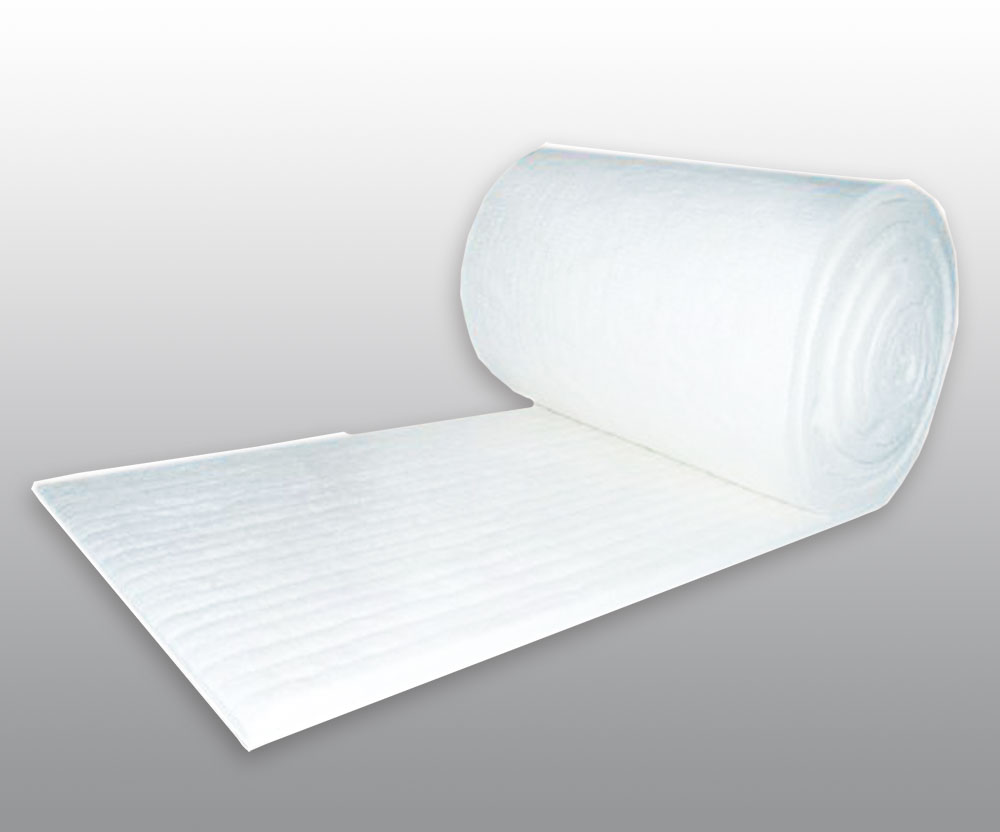
ceramic fiber blanket As a core thermal insulation material in high-temperature industrial applications, ceramic fibre blankets are widely used in kiln linings, thermal pipe insulation and the protection of high-temperature equipment. Although they possess excellent high-temperature resistance, prolonged use can lead to localised damage caused by mechanical friction, thermal stress concentration or chemical corrosion. If not repaired promptly, this may result in insulation failure, equipment overheating or even production accidents. Today, Mu Yi will systematically outline emergency repair solutions for five typical scenarios, based on common types of damage encountered in industrial settings, and provide practical technical guidance.
ceramic fiber blanket I. Edge Cracking and Roughness: Precise Repair of Micrometre-Level Damage
Scenario Characteristics: Linear cracks less than 5 mm wide or rough fibres appear at the edges, commonly caused by mechanical tugging during installation or stress release resulting from thermal cycling.
Repair Steps:
Pre-treatment: Wear a dust mask and powder-free gloves. Use round-tipped scissors to trim along the edge of the crack, removing the frayed section. The trimmed width should be 2–3 mm wider than the damaged area to ensure a smooth cut.
Sanding: Lightly sand the edges with fine-grit sandpaper (800 grit or higher) to remove any residual fibre burrs, preventing roughness from affecting subsequent bonding.
Adhesive Application: Apply a high-temperature-resistant adhesive (such as an alumina silicate-based adhesive) evenly to a thickness of 0.1–0.2 mm, covering 50 mm on either side of the crack. If the crack is located on the bonding surface, apply the adhesive to the original installation surface simultaneously.
Pressure Curing: Use a PTFE scraper to apply light pressure to the repair area. After expelling any air, leave to cure at room temperature for 24 hours. If the equipment needs to be put into service urgently, curing can be accelerated by drying in an environment of 60–80°C for 1–2 hours.
Technical Points: Edge repairs require strict control of the adhesive thickness; excessive thickness may lead to increased heat conduction, whilst insufficient thickness may compromise bonding strength. A case study from a petrochemical enterprise demonstrates that the thermal conductivity of the edge area increased by only 0.03 W/(m·K) after repair, with thermal insulation performance remaining virtually unaffected.
ceramic fiber blanket II. Localised Holes: Three-dimensional Repair of Millimetre-scale Penetration Damage
Scenario Characteristics: Holes with a diameter of <20 mm, often caused by chemical corrosion or impact from foreign objects, commonly found in areas of chemical furnaces exposed to acidic or alkaline environments.
Repair Steps:
Patch Preparation: Cut a patch of ceramic fibre paper of the same type to match the shape of the hole. For circular holes, the patch diameter should be 20 mm larger; for square holes, the side length should be 20 mm longer, ensuring coverage of the hole and a 5–10 mm surrounding area.
Cleaning: Blow dust from inside and outside the hole using compressed air (pressure ≤ 0.2 MPa). If corrosion residues are present, wipe them away with a cotton swab soaked in industrial alcohol.
Multi-layer bonding: Apply an even layer of adhesive (0.15 mm thick) within a 10 mm radius of the hole and onto the bonding surface of the patch. Align and apply the patch, then use a scraper to press lightly 3–5 times to expel any air. To enhance strength, cover the outer edge of the patch with fibreglass reinforcement fabric and secure it with adhesive, ensuring the edges of the reinforcement fabric extend 10 mm beyond the patch.
Quality inspection: After 24 hours of curing, gently press the patch area with your hand to ensure there is no loosening, then use an infrared thermometer to measure the temperature difference between the repaired area and the surrounding surface. If the temperature difference exceeds 5°C, re-inspect the bonded layer for any delamination.
Technical Points: When repairing holes, priority should be given to patch materials with the same chemical composition as the original blanket to avoid secondary cracking caused by differences in thermal expansion coefficients. Practice at a certain steel enterprise has shown that, following repair with patches of the same material, the service life of the hole area is extended to 85% of that of the original blanket.
ceramic fiber blanket III. Delamination: Structural Repair of Interlayer Separation
Scenario Characteristics: Delamination areas are typically <100 cm², often caused by thermal shock or uneven application of adhesive during installation, and are commonly found in industrial furnaces and kilns subject to frequent start-stop cycles.
Repair Procedure:
Delamination Removal: Use a round-tipped craft knife to lift the edge of the delaminated section. If only a localised area is loose, remove the loose section whilst retaining the intact underlying layer; if complete separation has occurred, remove the upper layer and inspect the damage to both layers.
Surface Preparation: Sand the delaminated interface (the upper surface of the base layer and the lower surface of the top layer) with fine-grit sandpaper to remove aged adhesive and dust until the surface roughness reaches Ra 3.2 μm or higher, thereby enhancing adhesion.
Re-bonding: Apply adhesive evenly to the upper surface of the base layer (0.2 mm thick). Align and bond the top layer, then use a squeegee to press gently in a single direction to expel air from between the layers. Place stainless steel weights (500g weights per 100cm² area) to maintain uniform pressure, and leave to cure for 24 hours.
Edge sealing: After curing, remove the weights and apply a ring of adhesive (5–10mm wide) around the edges of the repaired delamination area to form a seal and prevent moisture ingress.
Technical points: Strict control of the pressure applied by the weights is essential during delamination repairs; excessive pressure can cause fibre compression and deformation, whilst insufficient pressure will compromise bond strength. A case study at a thermal power plant demonstrated that the tensile strength of the repaired delaminated area recovered to 92% of that of the original mat.
ceramic fiber blanket IV. Extensive Damage: Systematic Repair of Penetrating Damage
Scenario Characteristics: Damage area >100 cm² or the presence of penetrating holes, typically caused by mechanical impact during equipment maintenance or thermal stress.
Repair Steps:
Removal and Cleaning: Switch off the equipment power supply; once the temperature has dropped to room temperature, remove the damaged blanket. Thoroughly blow-clean the installation surface with a compressed air gun to remove any residual adhesive and dust.
Cutting the New Blanket: Cut the new blanket to size using a specialised cutting machine, ensuring the dimensions are 5–10 mm larger than the installation area to allow for a 5–10 mm overlap with the intact blanket at the edges.
Adhesive Application and Installation: Apply the adhesive evenly to the installation surface (0.2 mm thick). After positioning the new blanket, use a squeegee to press gently and expel air, ensuring there are no creases or voids. If there are overlapping areas, apply additional adhesive to the overlapping surfaces to strengthen the bond, and reinforce the edges with high-temperature-resistant tape (10–15 mm wide).
Performance verification: Allow the installation to cure for 24 hours after completion. Once the equipment is operational, use an infrared thermometer to check the temperature distribution, ensuring there are no localised hot spots (temperature difference ≤ 3°C). Simultaneously, conduct an airtightness test (by introducing compressed air at 0.1 MPa and applying soapy water to the outer surface); the test is considered successful if no bubbles are detected.
Technical Points: For large-scale repairs, prioritise the use of new blankets with a thermal conductivity matching that of the original, to avoid increased energy consumption due to differences in thermal resistance. Practical experience at a certain aluminium company demonstrates that, following repairs, furnace temperature uniformity improved by 12% and electricity consumption per tonne of aluminium decreased by 3.5%.
ceramic fiber blanket V. Repair of Contraction Joints: Repair of linear defects caused by thermal expansion
Scenario characteristics: Gap width ≥ 5 mm, typically caused by crystallisation and grain growth in ceramic fibre blankets at high temperatures; commonly found in industrial furnaces and kilns that have been in operation for a long time.
Repair steps:
Gap cleaning: Blow dust out of the gap using compressed air; if there are clumps of binder, gently sand them away with fine-grit sandpaper.
Filling Material: Select ceramic fibre blankets of the same grade as the original material. Cut the material to a width 10–15 mm wider than the gap to ensure it can be compressed and compacted after insertion.
Deep Filling: Push the filling material as far into the gap as possible until it can no longer be compressed, to prevent surface-level filling that may lead to detachment during operation.
Surface levelling: Gently press the packed area with a scraper to ensure it is flush with the original blanket surface, thereby reducing thermal resistance.
Technical points: When repairing expansion joints, the compression ratio of the packing material must be controlled. Over-compression can lead to excessive fibre density, which affects thermal insulation performance, whilst under-compression fails to effectively block heat flow. A case study from a glass manufacturer demonstrated that, following repair, heat loss in the joint area was reduced by 18% and the furnace surface temperature dropped by 25°C.
Conclusion: Repair is not the end, but the beginning of extended service life
Localised repair of ceramic fibre blankets is not merely a technical operation, but a form of in-depth maintenance for equipment safety and production efficiency. By tailoring repair solutions to specific scenarios and adhering to the three principles of material compatibility, complete sealing and high-temperature resistance, thermal insulation and sealing performance can be effectively restored, extending service life by 30%–50%. For enterprises, mastering scientific repair methods not only reduces replacement costs but also minimises equipment downtime, thereby enhancing overall production efficiency. In the era of Industry 4.0, the precision repair of ceramic fibre blankets will become a crucial element in reducing costs and improving efficiency within the high-temperature industrial sector.