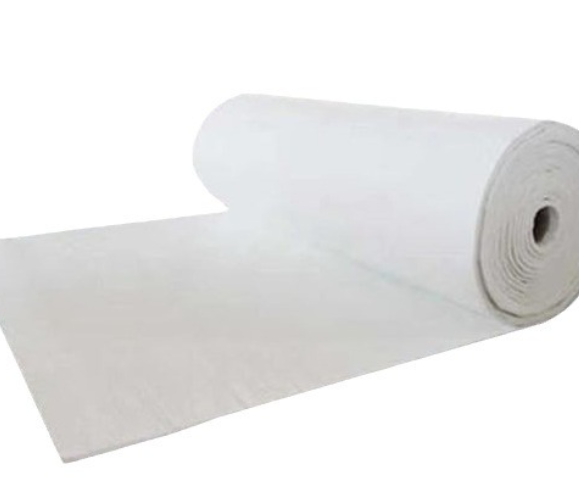
As a core material in the field of industrial high-temperature thermal insulation, s are widely used in the metallurgical, petrochemical, power generation and aerospace sectors due to their lightweight nature, high-temperature resistance and low thermal conductivity. However, issues such as dust pollution and the release of harmful substances associated with traditional refractory materials have always been key bottlenecks limiting their environmental performance. Today, Mu Yi provides an in-depth analysis from four perspectives—material composition, production processes, international certification systems and environmental application scenarios—to explain how ceramic fibre blankets achieve the environmental objective of ‘zero harmful dust and zero release of harmful substances’ through technological innovation and standard certification.
I. Eco-friendly Design of Material Composition
1. Purity Control of Natural Mineral Raw Materials
The core raw materials of ceramic fibre blankets are natural minerals such as hard clay clinker, feldspar, aluminium oxide and silica powder, which are processed into fibres through high-temperature melting (above 1,800 °C) and a spinning process. In high-quality products such as Aesop ceramic fibre blankets, the Al₂O₃ content ranges from 42% to 72 per cent, the SiO₂ content from 28 per cent to 58 per cent, and the impurity content is strictly controlled below 0.5 per cent, thereby eliminating the introduction of heavy metals (such as lead and cadmium) at source.
2. Breakthroughs in the Biocompatibility of Soluble Fibres
Addressing the non-biodegradable nature of traditional ceramic fibres, companies such as Jinan Huolong have developed soluble ceramic fibre blankets. Composed primarily of SiO₂, MgO and CaO, these blankets dissolve slowly in human body fluids, with dissolution rates complying with the requirements of the ISO 18895:2015 standard. With a refractoriness of 600°C–800°C, these products are suitable for fire protection applications in civil buildings where temperature requirements are not particularly high, thereby significantly reducing the risks associated with long-term exposure.
II. Environmental Control System for Production Processes
1. Fully Enclosed Automated Production Lines
Modern ceramic fibre blanket production lines utilise integrated multi-machine automated systems, operating in a fully enclosed environment throughout the entire process—from raw material melting and fibre spinning to needle-punching. For example, Hebei Guomei Building Materials’ aluminium silicate spun-fibre blanket production line is equipped with a negative-pressure dust collection system, with dust emission concentrations of ≤5 mg/m³, which is far below the limit of 120 mg/m³ specified in GB 16297-1996, the ‘Comprehensive Emission Standard for Atmospheric Pollutants’.
2. Precise Control of Fibre Diameter and Dust Particle Size
By adjusting the spinning process parameters (such as melt viscosity and spinning disc rotational speed), precise control of fibre diameter can be achieved. The ASTM C1670-18 standard requires that the fibre diameter of ceramic fibre blankets be ≤5 μm, whilst ISO 1887:2014 further stipulates that fibres with a diameter of ≥3 μm must not account for more than 10 per cent of the total. This fine-denier design not only enhances thermal insulation performance but also reduces the generation of respirable dust.
3. Environmentally Friendly Alternatives to Binders and Additives
Traditional ceramic fibre blankets rely on organic binders such as phenolic resins, which may release harmful substances such as formaldehyde at high temperatures. New products, such as the Isso reinforced double-sided needle-punched blanket, utilise a physical interlacing process that completely eliminates the need for chemical binders. Structural stability is achieved by increasing the fibre interlacing density (≥120 kg/m³), ensuring that no volatile organic compounds (VOCs) are released at temperatures as high as 1,260 °C.
III. Key Indicators of International Environmental Certification Schemes
1. Compliance with the EU REACH Regulation
Ceramic fibre blankets exported to the EU must pass the REACH Regulation’s SVHC (Substances of Very High Concern) screening to ensure they do not contain substances listed on the list of hazardous substances, such as polycyclic aromatic hydrocarbons (PAHs) and flame retardants (e.g. HBCDD). For example, a company’s products were tested by SGS and found to be free of all 197 SVHCs, thereby meeting the exemption criteria for inorganic fibres set out in Article 51 of Annex XVII to REACH.
2. US EPA Fibre Dust Emission Standards
According to the US EPA’s 40 CFR Part 61 ‘National Emission Standards’, the emission limit for respirable dust (PM4) in ceramic fibre blanket production workshops is 0.05 f/cm³ (fibres per cubic centimetre). In actual production, wet dust collection and HEPA filtration systems can control workshop dust concentrations to below 0.01 f/cm³, which is well below the regulatory requirements.
3. China Classification Society (CCS) Certification for Marine Applications
In response to the specific requirements of the shipbuilding industry, CCS has established the ‘Rules for Type Approval of Marine Refractory Materials’, which stipulate that the fire performance of ceramic fibre blankets must meet the A60 standard (fire integrity ≥ 60 minutes) and that smoke toxicity must comply with ZQ1 class (toxicity index ≤ 5). Hebei Guomei Building Materials is the only enterprise in China to have obtained CCS A60 type approval for marine products; its products are used in the thermal insulation layers of ocean-going cargo ships.
IV. Verification of Environmental Performance and Application Scenarios
1. Energy Conservation and Emission Reduction in Industrial Furnaces
In blast furnace hot blast stoves within the steel industry, the use of 1400 zirconia-containing ceramic fibre blankets (HLGX-512) to replace traditional heavy-duty refractory bricks reduces the surface temperature of the furnace walls from 200°C to 80°C, thereby reducing heat loss by 40 per cent. This product is certified in accordance with GB/T 17911-2018 ‘Test Methods for Refractory Materials – Ceramic Fibre Products’, with a permanent linear change rate under heating of ≤4% (1400°C × 24h), ensuring long-term stability.
2. Green Upgrades for Building Fire Protection
The application of soluble ceramic fibre blankets in fire separation zones within civil buildings addresses the shortcomings of traditional rock wool boards, such as their susceptibility to water absorption and low strength. For example, Jinan Huolong’s products have obtained Class A1 certification under GB 8624-2012 ‘Classification of Fire Performance of Building Materials and Products’, with a flame spread rate index (FIGRA) of ≤120 W/s, meeting the fire safety requirements for super-high-rise buildings.
3. Dust Control During Construction
To address dust issues arising during the installation of ceramic fibre blankets, companies have developed配套 negative-pressure dust extraction equipment and dust-proof suits. For instance, Zhengzhou Shengshi Jinding’s construction kit is fitted with high-efficiency filter cartridges (filtration efficiency ≥99.97 per cent) which, when combined with an on-site spray dust suppression system, can control dust concentrations in the work area to below 1 mg/m³, far below the 8 mg/m³ limit specified in GBZ 2.1-2019 ‘Occupational Exposure Limits for Hazardous Factors in the Workplace’.
V. Technological Trends and Standardisation
1. The Environmental Potential of Nanoscale Fibres
With the advancement of nanotechnology, the diameter of ceramic fibres has fallen below 1 μm. The thermal conductivity of such nanofibre blankets can be as low as 0.03 W/(m·K) (at 400 °C), and the dust particles are smaller, making them easier to capture by high-efficiency dust collection equipment. However, their biocompatibility requires further validation in accordance with standards such as ISO/TR 10993-23:2021 *Biological Evaluation of Nanomaterials for Medical Devices*.
2. Recycling within a Circular Economy Model
Some enterprises have begun to explore recycling and remanufacturing technologies for ceramic fibre blankets. For example, after subjecting waste fibre blankets to high-temperature purification (1,200 °C), they can be remelted and spun to produce lower-grade thermal insulation felt. This process must comply with the requirements of the ISO 14001 Environmental Management System to ensure that energy consumption and emissions during the recycling process are 30 per cent lower than those of virgin fibre production.
Conclusion
The enhanced environmental performance of ceramic fibre blankets is the result of collaborative innovation across materials science, production processes and regulatory standards. From the careful selection of natural mineral raw materials, to the application of fully enclosed automated production lines, and on to breakthroughs in soluble fibres and nanotechnology, the industry is gradually establishing a ‘zero-dust, zero-emission’ green manufacturing system. In the future, with the continuous upgrading of international environmental standards (such as the EU’s Carbon Border Adjustment Mechanism, CBAM), ceramic fibre blanket manufacturers will need to further strengthen their whole-life-cycle management and, through technological leadership and compliance with standards, secure a foothold in the global high-end market.