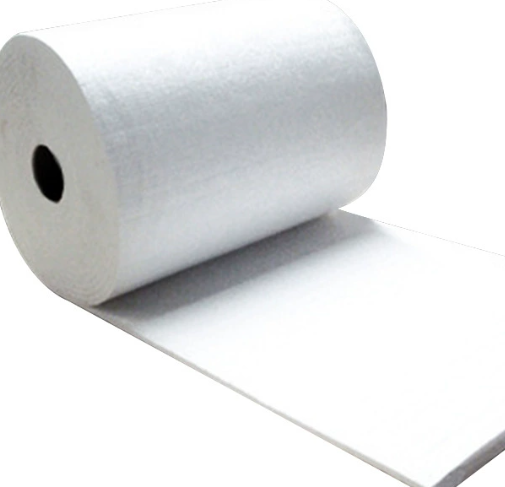
With industrial safety and environmental standards becoming increasingly stringent, ceramic fibre paper has emerged as a core material in high-temperature industrial equipment, new energy batteries and the aerospace sector, thanks to its excellent high-temperature resistance, low thermal conductivity and lightweight properties. However, compliance with fire safety standards is directly linked to a product’s ability to enter international markets. UL 94 V-0 certification, as a globally recognised standard for the flame retardancy rating of plastics and fibre materials, is key to overcoming technical barriers for ceramic fibre paper. Today, Mu Yi will provide a systematic analysis of the entire process for ceramic fibre paper to obtain UL 94 V-0 certification, offering enterprises practical technical guidance.
I. The Core Value of UL 94 V-0 Certification
UL 94 V-0 represents the highest rating in vertical burning tests. It requires that, following two 10-second exposures to flame, the flame must be completely extinguished within 30 seconds, and any burning droplets must not ignite the cotton wool placed beneath. The significance of this standard for ceramic fibre paper is reflected in three aspects:
Market Access: Certifications such as the EU’s CE and North America’s UL all require materials to achieve V-0 rating; otherwise, they cannot enter the European or North American markets;
Safety Endorsement: In applications such as battery thermal insulation and industrial furnace sealing, V-0-rated materials can reduce the risk of fire spread;
Technical Premium: Certified products can command a price premium of up to 20–30 per cent, enhancing a company’s competitiveness.
Taking a certain new energy battery manufacturer as an example, if the ceramic fibre paper it uses fails to obtain V-0 certification, the battery pack may experience thermal runaway during a needle penetration test due to material combustion, directly leading to the risk of a product recall.
II. The Complete Certification Process: From Sample Preparation to Report Interpretation
1. Sample Preparation: Details Determine Success or Failure
Dimensions and Quantity: Ten samples measuring 127 mm × 12.7 mm × actual thickness must be provided (e.g., for a thickness of 1.5 mm, label as ‘V-0 @1.5 mm’), of which five are used for routine testing and five for 70°C ageing pre-treatment;
Surface Treatment: The sample surface must be free of oil, coatings or impurities; otherwise, test failure may occur due to abnormal burning rates;
Thickness Control: The flame-retardant performance of materials with the same formulation varies significantly at different thicknesses. For example, a company’s 1.0 mm thick ceramic fibre paper passed V-0 certification, but the 0.8 mm thick sample failed to meet the standard due to insufficient fibre density.
2. Pre-treatment: Simulated Environment
Temperature and Humidity Control: Samples must be left in an environment of 23°C/50% RH for 48 hours to eliminate the influence of environmental factors on combustion performance;
High-Temperature Ageing: Some clients require simulation of long-term use at 70°C; in such cases, samples must undergo a 7-day ageing treatment to assess the material’s flame-retardant stability at high temperatures;
Low-Temperature Testing: For aerospace applications, a low-temperature shock test at –40°C is also required to ensure the material does not become brittle at low temperatures.
3. Vertical Burning Test: Analysis of Key Indicators
Test Equipment: A Bunsen burner compliant with UL standards is used, with the flame height precisely controlled at 20 mm; the blue flame makes contact with the sample at a 90° angle;
Test Procedure:
First 10-second burn: Record the self-extinguishing time after the flame is removed and observe any dripping behaviour;
Second 10-second burn: Repeat the test to assess the material’s stability under continuous thermal shock;
Cotton wool ignition test: If the drippings ignite the cotton wool below, the test is deemed a failure even if the self-extinguishing time meets the standard.
Pass criteria:
Single self-extinguishing time ≤ 10 seconds;
Total duration of two burn cycles ≤ 50 seconds;
No drippings ignite the cotton wool;
No smouldering (persistent red glow) for more than 30 seconds after the flame is removed during the second burn cycle.
4. Interpretation of Reports and Subsequent Optimisation
Report content: Must include the material name, thickness, pre-treatment conditions, classification result and a link to the combustion video (provided by some organisations);
Pitfalls of invalid reports: Reports that do not specify the thickness (e.g. stating only ‘V-0 grade’) may be rejected by clients; it is necessary to clearly state ‘@specific thickness’;
Failure Analysis: If the test is failed, FTIR analysis of the combustion residues can be conducted to identify the root cause of the problem (e.g. migration of flame retardants, uneven fibre distribution);
Formulation Optimisation: Adjust the type and proportion of flame retardants based on the test results. For example, a certain company improved its V-0 pass rate whilst reducing toxicity by replacing brominated flame retardants with a phosphorus-nitrogen synergistic system.
III. Technical Challenges and Solutions
1. Control of Combustion Drip-Off
Problem: At high temperatures, ceramic fibre paper may produce drip-off due to fibre melting, which could ignite the cotton beneath it.
Solution:
Add a charring agent (such as the APP/PER intumescent system) to promote the formation of a carbonised layer on the surface, thereby preventing drip-off;
Optimise the fibre weaving process to increase the material’s density and reduce the risk of melting.
2. Balancing Thickness and Flame Retardancy
Issue: Reducing material thickness can lower costs, but may result in a decline in flame retardancy.
Case Study: A company’s 1.5 mm thick ceramic fibre paper achieved V-0 certification, but failed testing when the customer requested a reduction to 1.2 mm.
Solutions:
Adopt nanofibre technology to increase the number of fibres per unit area;
Introduce an aerogel composite structure to enhance thermal insulation whilst maintaining lightweight properties.
3. Long-Term Thermal Ageing Stability
Issue: Following prolonged use at high temperatures, flame retardants may migrate or decompose, leading to a decline in performance.
Countermeasures:
Conduct long-term thermal ageing tests in accordance with the UL 746B standard (e.g. 1,000 hours at 150°C);
Select flame retardants with higher thermal stability (e.g. organophosphorus compounds instead of halogenated compounds).
IV. Selection of Certification Bodies and Cycle Management
1. Requirements for Body Qualifications
Prioritise laboratories accredited by CNAS, CMA and UL (e.g. Shenzhen Sait Testing, SGS, etc.) to ensure global recognition of reports;
Confirm whether the body possesses dedicated equipment for vertical burning tests (e.g. flame height calibrators, high-speed camera systems).
2. Optimisation of the Certification Cycle
Standard process: Sample preparation (3 days) + pre-treatment (7 days) + testing (2 days) + report issuance (3 days) = approximately 15 days;
Express service: Some bodies offer a 3-day express service (including pre-treatment), subject to an additional fee;
Annual retesting: Retesting is required following changes to material formulations or production processes; it is recommended to enter into a long-term cooperation agreement with the body to benefit from priority scheduling.
V. Industry Trends and Future Outlook
As global requirements for material safety continue to rise, UL 94 V-0 certification is exhibiting the following trends:
Integration of multiple standards: Enterprises must simultaneously comply with UL 94, GB/T 2408 (Chinese national standard) and EN 13501-1 (EU standard), driving testing organisations to develop ‘one test, multiple reports’ services;
Intelligent Testing: AI image recognition technology can automatically measure flame height and afterglow duration, thereby reducing human error;
Blockchain Traceability: Some organisations utilise blockchain technology to store test process data, enhancing the credibility of reports (as required by Tesla’s supply chain, for example).
Conclusion
UL 94 V-0 certification for ceramic fibre paper is a complex interplay of technology, management and market strategy. Companies must incorporate flame-retardant principles from the sample design stage, select authoritative testing bodies, and achieve a balance between performance and cost through continuous optimisation of formulations and processes. With the deep integration of green manufacturing and intelligent testing technologies, fire safety certification for ceramic fibre paper will become more efficient and transparent in the future, providing a solid safeguard for global industrial safety.