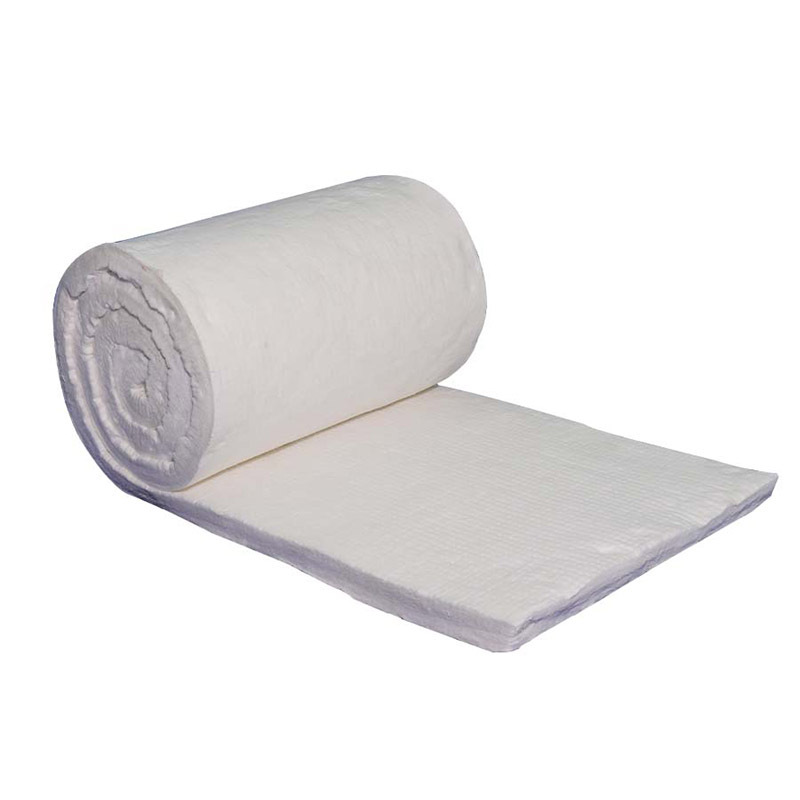
Amid the trend towards greener industrial materials, soluble ceramic fibre blankets have emerged as an ‘environmentally friendly alternative’ in sectors such as industrial thermal insulation, building fire protection and environmental protection equipment, thanks to their excellent biodegradability and high-temperature resistance. However, whilst striving to achieve environmental sustainability, these materials still face multiple technical challenges relating to heat resistance, cost and production processes. Today, Mu Yi will analyse how soluble ceramic fibre blankets balance performance and sustainability from four perspectives: material properties, technical challenges, application scenarios and innovation pathways.
I. Material Properties: Dual Breakthroughs in Biodegradability and High-Temperature Resistance
Soluble ceramic fibre blankets consist primarily of SiO₂ (72–74 wt%), CaO (23–25 wt%) and MgO (0.1–0.8 wt%), and belong to the alkaline earth silicate system. The core innovation lies in the introduction of calcium and magnesium oxides, which enables the fibres to dissolve in human body fluids, with a half-life of less than 10 days and a dissolution rate exceeding 100 ng/cm²·h, meeting the EU NOTA Q standard for non-carcinogenic substances. This characteristic makes it an environmentally friendly alternative to traditional refractory ceramic fibres (RCF), particularly suitable for industrial applications where health risks are a concern.
In terms of performance, the soluble fibres are produced via a melt-spinning process, and the product forms include blankets, boards and sheets. They can withstand temperatures of up to 1,260 °C, with short-term resistance to 1,300 °C; their linear shrinkage rate is less than 3.5 per cent (at 1,260 °C for 24 hours); their thermal conductivity is as low as 0.032–0.038 W/m·K (at 40 °C); their tensile strength ranges from 1.8 to 2.2 MPa; and their tear resistance is superior to that of traditional fibres.
II. Technical Challenges: The ‘Balance’ Between Heat Resistance and Cost
Although soluble fibres demonstrate outstanding environmental performance, technical bottlenecks continue to constrain their large-scale application:
1. Decline in heat resistance: the ‘double-edged sword’ of low-melting-point compounds
Whilst the introduction of CaO and MgO has broadened the viscosity range for fibre formation and enhanced fibre softness, the resulting low-melting-point compounds—such as CaO·SiO₂ and CaO·MgO·2SiO₂—lead to a reduction in the fibres’ heat resistance. For example, traditional aluminosilicate fibres can withstand temperatures up to 1,400 °C, whereas soluble fibres are typically limited to applications below 1,260 °C. To address this shortcoming, the industry has increased the viscosity of the glass phase by adding ZrO₂ (0.5–3 wt%), thereby suppressing grain growth rates and raising the temperature resistance of some products to 1,300 °C; however, this comes at the cost of increased production costs.
2. Complexity of the production process: the ‘gap’ between the laboratory and industrialisation
The production of soluble fibres requires the raw materials to be melted in an electric arc furnace at 1,700–1,900 °C, spun into fibres via a spinning roller operating at 120–180 m/s, and then processed into mat-like materials through a needling process. This process imposes stringent requirements on parameters such as temperature control, fibre-forming distance (1,000–1,500 mm) and the content of non-fibrous substances (≤1 wt%). Although domestic enterprises have achieved an annual production capacity of 300,000 tonnes, the fibre formation rate and uniformity of fibre length for high-end products (such as zirconium-containing types) still lag behind international standards, leading to fluctuations in yield rates.
3. Cost pressures: the ‘tug-of-war’ between environmental premiums and market acceptance
The production cost of soluble fibres is 20–30 per cent higher than that of traditional fibres, primarily due to raw material purity requirements (e.g. SiO₂ must be 99.9 per cent or higher), the use of ZrO₂ additives, and stricter environmental treatment measures (e.g. binder-free production). Although national energy-saving and emission-reduction policies are driving demand growth, price-sensitive customers still tend to opt for low-cost alternatives, thereby limiting market penetration.
III. Application Scenarios: ‘Cross-sector’ Applications from Industrial Thermal Insulation to Health Protection
The environmentally friendly properties of soluble fibres enable them to demonstrate their value in the following areas:
1. Sealing of industrial furnaces and thermal insulation of high-temperature pipelines
In non-ferrous metal foundries and petrochemical pipeline systems, soluble fibre blankets reduce heat loss whilst preventing the release of harmful substances that occurs with traditional fibres when exposed to high temperatures over extended periods. For example, our Mu Yi 1260°C fibre blanket has been used in automotive engine heat shields, replacing imported products.
2. Building Fire Protection and Marine Insulation
Used as core filling material for fire doors and as reinforcing fibres in fire-retardant coatings for steel structures, soluble fibres meet the requirements for Class A non-combustible materials set out in the ‘Code for Fire Protection in Architectural Design’. They account for 38 per cent of fire-resistant insulation layers in ship compartments, thereby reducing the risk of fire.
3. Environmental Protection Equipment
In equipment such as waste incinerators and desulphurisation towers, soluble fibres serve as thermal insulation linings in flue gas treatment systems. They reduce damage to equipment caused by high-temperature corrosion whilst eliminating the dust hazards associated with traditional fibres during maintenance.
4. Health-Sensitive Environments
In environments with stringent air quality requirements, such as semiconductor manufacturing and pharmaceutical laboratories, the biodegradability of soluble fibres reduces the risks associated with long-term exposure. For example, the zirconium-containing fibre blanket produced by Zibo Mu Yi Materials Co., Ltd. has passed the ISO 22459 biodegradability test and has become the material of choice for cleanroom insulation.
IV. Innovation Pathways: ‘Breaking Through’ from Material Design to Industrial Collaboration
To overcome technical bottlenecks, the industry is exploring innovation in the following areas:
1. Composition optimisation: Balancing heat resistance and solubility
By adjusting the CaO/MgO ratio (e.g. 23–25 wt%: 0.1–0.8 wt%) and combining this with ZrO₂ gradient doping technology, precise control over temperature resistance levels and dissolution rates can be achieved. For example, the ‘quantum-level sol-gel regulation technology’ developed by Mu Yi reduces particle size to below 80 nm, thereby increasing the tensile strength of the fibres to 3.2 GPa, approaching international advanced standards.
2. Process Upgrades: Digital Manufacturing Boosts Yield Rates
The introduction of AI-driven adaptive process control systems enables real-time optimisation of parameters such as sintering temperature, pressure and atmosphere. The “Digital Twin System” established by Liya New Materials, trained using 100,000 sets of process data, has increased product yield rates from 78 per cent to 92 per cent whilst reducing the technology iteration cycle by 50 per cent.
3. Industry Chain Collaboration: Establishing a Full-Chain Standards System
Drawing on Toray Industries’ full-chain ‘powder–moulding–testing’ standards, domestic enterprises are promoting collaboration across the upstream and downstream sectors. For example, the ‘Common Technology Platform for Ceramic Fibre Paper’ established by the Jiangsu New Materials Industry Alliance has standardised 12 key indicators—including powder particle size and sintering temperature—thereby improving the efficiency of industry chain coordination by 40 per cent.
4. Policy Guidance: Environmental Premiums and Market Incentives
With the implementation of the national standard ‘Refractory Fibres and Products’ (GB 3003-2017), the government is encouraging enterprises to develop high-end products through policies such as tax incentives and green procurement. It is projected that by 2027, demand for soluble fibres in the industrial insulation sector will grow to 120,000 metric tonnes per annum, driving the industry’s transformation from ‘low-end substitution’ to ‘systemic innovation’.
Conclusion: The Struggle for Technological Sovereignty in Sustainable Materials
Competition in the field of soluble ceramic fibre blankets is, at its core, a four-pronged contest involving material composition, preparation processes, equipment manufacturing and industrial chain synergy. As a major producer of ceramic fibres, China must not only achieve breakthroughs in individual technologies but also establish a full-chain innovation ecosystem spanning from powder materials to end products. This silent technological revolution is not only crucial to the realisation of environmental protection goals but will also redefine the competitive landscape of the global new materials industry.