Traditionally, fully premixed condensing boilers have utilised insulation materials such as ceramic fibre boards (aluminium silicate fibre boards). During use, these materials are prone to pulverisation; the resulting dust particles can adhere to the heat exchange coils or fall into the heat exchange chamber, causing the heat exchanger to become blocked and severely impairing the boiler’s heat exchange efficiency. Furthermore, exposure to condensate causes the ceramic fibre boards to delaminate, deform and collapse, necessitating frequent replacement and resulting in a significant increase in after-sales maintenance costs.
When used in condensing heat exchangers, vitrified vermiculite insulation boards can withstand long-term immersion in condensate without delamination, disintegration, dust generation or collapse. With a heat resistance exceeding 1,200 °C, they are guaranteed not to deform or melt at high temperatures. When vitrified insulation boards are subjected to continuous, uninterrupted operation for 60 days in the harsh working environment of a condensing heat exchanger, not only do their performance indicators show no deterioration, but the high-temperature firing during the heat exchanger’s operation causes all free water and crystalline water within the material to be completely evaporated and released, resulting in the formation of numerous pores within the boards. Simultaneously, the easily oxidisable substances in the material were oxidised, removing impurities such as carbon dioxide and thereby purifying the vitrified vermiculite boards.
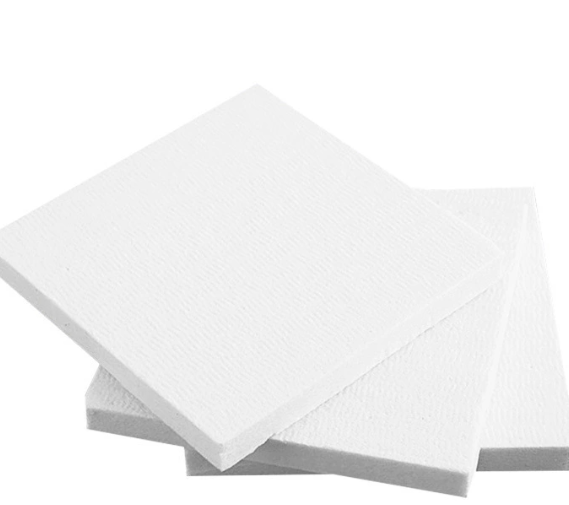
The residual solid components in the inorganic water-based binder used in the vitrified insulation boards crystallise due to the high temperatures, causing the entire product to undergo a semi-vitrification process; hence the name ‘vitrified vermiculite insulation boards’. The product’s compressive and flexural strengths are enhanced by this crystallisation, whilst its surface hardness is also significantly improved. This overcomes the various drawbacks associated with ceramic fibre boards used in condensing heat exchangers, resulting in an exceptionally long service life that matches that of the machinery, equipment and pipework.