In today’s era of rapidly advancing technology, the research, development and application of new materials have become a key driving force behind progress across all industries. Ceramic fibre boards, as a high-performance, multi-functional refractory and thermal insulation material, have undergone a development journey fraught with challenges and innovation from the laboratory to the market, whilst their vast application prospects are truly remarkable.
I. Laboratory Research and Development: Technical Breakthroughs and Innovation
The development of ceramic fibre boards began with laboratory-based exploration into new types of refractory materials. Early ceramic fibre materials relied primarily on natural mineral fibres; however, as industrial technology advanced and demands on material performance grew, natural fibres could no longer meet these requirements. Consequently, scientists began to focus their efforts on the research and synthesis of artificial ceramic fibres.
Through continuous experimentation and optimisation in the laboratory, researchers successfully developed ceramic fibres with outstanding properties. These fibres are not only lightweight and high-strength but also possess excellent high-temperature resistance, thermal insulation and corrosion resistance. Subsequently, they processed these fibres into ceramic fibre boards using a wet vacuum moulding process, further enhancing the material’s overall performance.
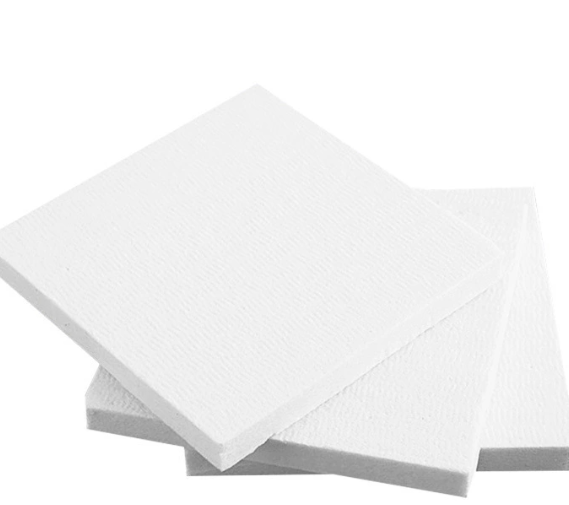
Technical breakthroughs were pivotal during the R&D process. For instance, improving the fibre preparation process increased the fibres’ strength and toughness, whilst optimising the moulding process ensured the structural uniformity and stability of the ceramic fibre boards. Furthermore, R&D personnel are constantly exploring new material formulations to further enhance the performance and scope of application of ceramic fibre boards.
II. Market Applications: From Industrial Furnaces to Emerging Sectors
As ceramic fibre board technology continues to mature, its market applications are gradually expanding. Originally, ceramic fibre boards were primarily used for thermal insulation and heat retention in industrial furnaces, effectively improving the thermal efficiency and service life of the furnaces. However, this represents merely the tip of the iceberg in terms of their applications.
With the rapid development of emerging sectors such as new energy, environmental protection and aerospace, the application prospects for ceramic fibre boards are becoming even broader. In the new energy vehicle sector, ceramic fibre boards can serve as thermal insulation material for battery packs, enhancing battery safety and service life; in the environmental protection sector, they can be used for high-temperature flue gas filtration and exhaust gas treatment, effectively reducing environmental pollution; in the aerospace sector, ceramic fibre boards are widely used in thermal protection systems due to their lightweight and high-strength characteristics.
Furthermore, ceramic fibre boards are utilised in the construction and transport sectors due to their excellent sound-absorbing and sound-insulating properties. In high-rise buildings, they serve as sound-insulating materials, enhancing the comfort of the living environment; in transport vehicles such as high-speed trains and underground railways, they function as sound-insulating and thermal insulation materials, improving the passenger experience.
III. Future Outlook: Continuous Innovation and Green Development
Looking ahead, the prospects for the research, development and application of ceramic fibre boards remain vast. With technological progress and constant market changes, ceramic fibre boards will continue to see new technical breakthroughs and expand into new application areas.
On the one hand, researchers will continue to focus on improving the performance and quality of ceramic fibre boards, further enhancing their high-temperature resistance, thermal insulation and corrosion resistance through refinements to manufacturing processes and material formulations. On the other hand, they will also explore the potential applications of ceramic fibre boards in emerging fields, such as new energy storage and smart manufacturing.
At the same time, green development will become a key direction for the future of ceramic fibre boards. As environmental awareness continues to grow, demand for green and eco-friendly materials will also increase. As an inorganic material, ceramic fibre boards possess excellent environmental performance and align with modern society’s principles of sustainable development. Consequently, future research, development and application of ceramic fibre boards will place greater emphasis on environmental protection and sustainability.
IV. Conclusion
From the laboratory to the market, the research and development journey of ceramic fibre boards has been filled with challenges and innovation. Their outstanding performance and broad application prospects have made them a shining new star in the field of new materials. Looking ahead, with technological progress and constant market changes, ceramic fibre boards will continue to face new opportunities and challenges. We look forward to seeing further technological breakthroughs and innovative applications, contributing even more to the development of various industries.