Amidst the current trend towards the fusion of contemporary architecture and installation art, ceramic fibre blankets—a traditional industrial material—are breaking through functional boundaries in a disruptive manner, serving as a bridge between industrial rationality and artistic sensibility. Thanks to their lightweight nature, high-temperature resistance and high malleability, they have not only redefined the technical standards for architectural thermal insulation systems, but have also evolved into a spatial narrative language in the hands of artists, pioneering a new paradigm in industrial aesthetics.
I. The Material’s Origins: The Evolution from Industrial Insulation to Artistic Medium
Ceramic fibre blankets are composed primarily of aluminium oxide and silicon dioxide, forming a three-dimensional fibre network structure through the spinning and double-sided needling processes. This process endows them with three key advantages:
Ultra-lightweight: With a density of just one-fifth that of traditional refractory bricks, it can withstand temperatures of 1,430°C and has a thermal conductivity as low as 0.03 W/m·K at 800°C, making it an ideal choice for energy-efficient buildings amidst the global energy crisis.
Structural Versatility: Customisable thicknesses ranging from 0.5 to 10 mm, compatible with precision processing such as laser engraving and nano-coating, and capable of being woven into flexible, curved structures.
Environmental Adaptability: Maintains chemical stability in neutral and oxidising atmospheres, with a tensile strength of 0.04 MPa and excellent thermal shock resistance, capable of withstanding temperature differentials ranging from –200 °C to 1,430 °C.
These material properties have led to its widespread application in traditional industrial sectors, such as thermal protection systems for spacecraft, linings for metallurgical furnaces and kilns, and thermal insulation for petrochemical pipelines. However, when artists began to explore its artistic potential, the industrial origins of ceramic fibre blankets sparked a marvellous chemical reaction with artistic expression.
II. Spatial Narrative: Artistic Practices with Ceramic Fibre Blankets
1. Light and Shadow Sculpture: Capturing Dynamic Light and Shadow
In the installation *Lava Memory* at the Shenzhen Museum of Contemporary Art, the artist utilised the semi-translucent properties of ceramic fibre blankets to weave them into a layered, curved structure. When LED light penetrates from within, the variations in the blankets’ porosity create a gradient of light, simulating the visual effect of flowing lava. This interaction between the material and light imbues the static installation with a dynamic narrative across the temporal dimension.
2. Acoustic Theatre: The Acoustic Magic of Fibre Networks
The installation *Web of Silence* at the West Bund Museum in Shanghai transforms ceramic fibre blankets into a spherical structure three metres in diameter, filled with fibre modules of varying densities. When visitors step inside, sound waves undergo multiple reflections and absorptions within the fibre network, creating a unique acoustic experience. Experimental data shows that the installation achieves an absorption rate of 85 per cent for sound waves above 1,000 Hz, far exceeding that of traditional sound-absorbing materials.
3. Thermal Memory: Visualising Thermodynamic Aesthetics
In the ‘Temperature Folds’ project at Beijing’s 798 Art District, the artist combines ceramic fibre blankets with thermosensitive paint to create an interactive installation that records changes in ambient temperature. When visitors touch the fibre surface, the localised rise in temperature triggers a colour change in the paint, forming a ‘temperature fingerprint’. This thermal interaction between the material and the human body transforms abstract thermodynamic concepts into a tangible artistic language.
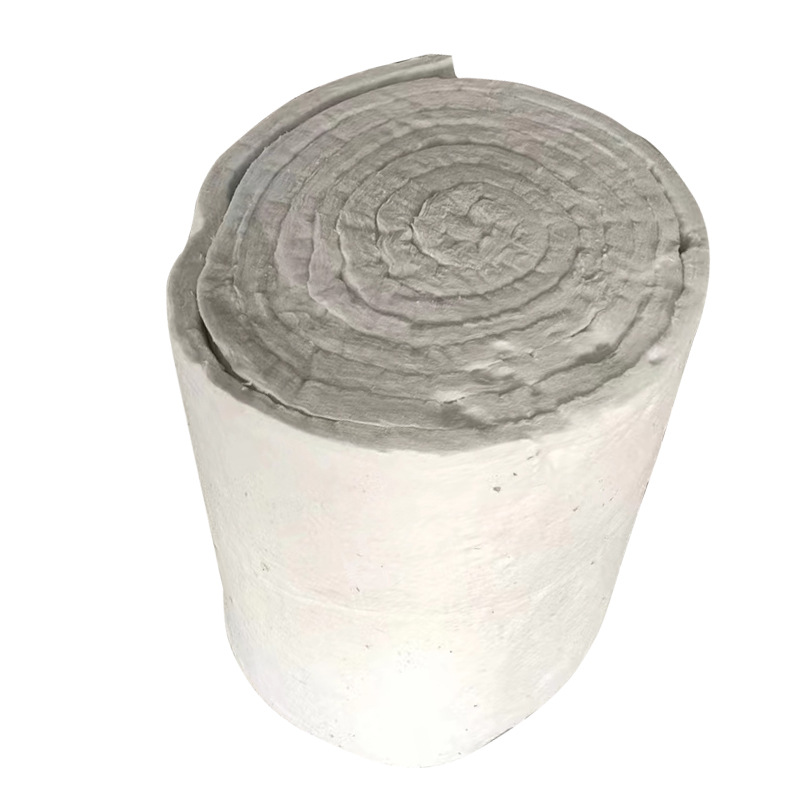 Ceramic Fibre Blanket
III. Technology-Driven Innovation: The Convergence of Industrial Materials and Digital Art
1. 3D Printing: A Breakthrough in Form—From Two Dimensions to Three
Through selective laser sintering technology, ceramic fibre blankets can be moulded into complex geometric structures in a single piece. An architectural practice utilised this technology to design a hyperbolic fibre blanket façade for the Museum of the Future in Dubai, where the surface porosity varies according to the building’s orientation, creating a textural effect whilst ensuring thermal insulation performance. This digital manufacturing process has enabled ceramic fibre blankets to transcend the limitations of traditional flat materials.
2. Intelligent Response: The Artistic Extension of Material Functionality
Ceramic fibre blankets automatically form a dense thermal barrier in the event of battery thermal runaway. An artist adapted this property for the installation *Safety Theatre*, using temperature sensors to control the blanket’s morphological changes. When a simulated thermal runaway occurs, the blanket undergoes a morphological transformation from soft to rigid within three seconds, providing a visual demonstration of the material’s safety performance. This fusion of functionality and artistry offers a new expressive paradigm for scientific and technological exhibitions.
3. Closed-Loop Recycling: The Practice of Sustainable Aesthetics
A European art collective created the installation *Circle of Recycling* using recycled ceramic fibre blankets. Through an electrofusion process, waste fibre blankets were regenerated into new material and then reprocessed into a ring-shaped structure. The installation not only demonstrates the material recycling process but also uses the circular form to symbolise the closed-loop concept of ecosystems. Data indicates that the performance of the regenerated fibre blankets differs by less than 5 per cent from that of virgin materials, demonstrating the feasibility of sustainability in industrial materials.
IV. Future Outlook: Cross-disciplinary Extensions of Industrial Aesthetics
Artistic applications of ceramic fibre blankets are breaking down the boundaries between traditional architecture and installation art:
Deep Space Art: NASA plans to utilise them for the interior decoration of Martian habitats, leveraging their radiation-resistant properties to create space art installations.
Deep-sea Aesthetics: A research team is developing pressure-resistant ceramic fibre blankets for the exterior cladding of deep-sea probes, ensuring structural stability under high-pressure conditions.
Metaverse Interfaces: Through nano-coating technology, ceramic fibre blankets can provide haptic feedback, serving as a physical interface for interaction between the virtual and real worlds.
From industrial kilns to art galleries, the evolutionary trajectory of ceramic fibre blankets reflects the innovative logic of materials science: When functional requirements reach a certain level, the material itself becomes a vehicle for artistic expression. This deep integration of industry and art not only redefines the aesthetic standards of architectural installations but also provides creative solutions for building a sustainable society. As the journal *Nature Materials* observed: ‘The artistic application of ceramic fibre blankets demonstrates that industrial materials can embody dual values—rationality and sensibility, function and form—simultaneously.’