In the industrial sector, the sealing performance of high-temperature equipment directly impacts production safety, energy efficiency, and service life. Traditional materials such as asbestos and glass fiber often pose leakage risks due to insufficient heat resistance and a tendency to age and crack. Recently, actual high-temperature sealing test data released by a domestic new materials research institute in collaboration with a leading industry enterprise has completely overturned conventional wisdom—this flexible material, woven from aluminum oxide and silicon dioxide nanofibers, maintains 98.6% sealing integrity even under extreme operating conditions at 1,200°C, establishing itself as an “all-rounder” in the field of high-temperature sealing.
I. Test Data: Four Core Metrics Completely Outperform Traditional Materials
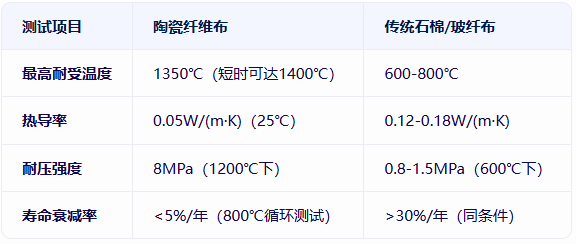
The research institute conducted over 500 hours of extreme testing on the ceramic fiber fabric by simulating real-world operating conditions in steel, petrochemical, and ceramic kilns. The key data is as follows:
Data Interpretation:
Temperature Adaptability: The ceramic fiber fabric maintains stable fiber structure even at 1200°C, whereas traditional materials exhibit brittle fracture at temperatures exceeding 800°C.
Energy Efficiency Advantage: Low thermal conductivity reduces heat loss by 30%–50%, which is highly significant for energy conservation in high-temperature kilns.
Mechanical Strength: Compressive strength at high temperatures is 5–10 times that of traditional materials, effectively preventing seal failure.
II. Technological Breakthroughs: Synergistic Effects of 3D Weaving Technology and Nanoscale Fibers
Behind the measured data lies a dual innovation in materials science:
Nanoscale fiber diameter (<2 μm): 50% finer than traditional fibers, forming a dense mesh structure with a porosity of less than 5%.
3D Weaving Technology: Intersections of warp and weft threads are reinforced with ceramic nodes, increasing tensile strength by 40% and eliminating fiber slippage.
Comparative Case Study:
In an application at a steel mill’s heating furnace, traditional sealing materials required replacement every three months, whereas the ceramic fiber fabric has operated stably for 18 months. Furnace temperature uniformity improved from ±30°C to ±8°C, resulting in annual natural gas cost savings exceeding 800,000 yuan.
III. Application Scenarios: A “Swiss Army Knife” from Aerospace to Civil Industry
Ceramic fiber cloth has passed rigorous certifications such as GB/T 30035-2013 “Test Method for High-Temperature Volume Stability of Refractory Materials” and is suitable for:
High-temperature kilns: Sealing of glass melting furnaces and ceramic roller kiln doors;
Petrochemicals: Flange seals for reactors in catalytic cracking units;
New Energy Sector: Insulation and protection for high-temperature areas of fuel cell stacks;
Aerospace: High-temperature deflector pad linings for rocket launch pads.
Expert Evaluation:
“Traditional sealing materials are ‘consumables’ at high temperatures, whereas ceramic fiber cloth functions more like a ‘functional component’—it can seal, insulate, and even serve as a structural element.”— —Professor Wang, Council Member of the Special Ceramics Branch, Chinese Society of Ceramics
IV. Selection Guide: How to Identify High-Quality Ceramic Fiber Cloth
Market products vary widely in quality; pay attention to the following parameters when purchasing:
Fiber Composition: Prefer high-alumina types with Al₂O₃ ≥ 75% for superior slag resistance;
Weight and Thickness: 800–1200 g/m² is suitable for most industrial applications;
Third-Party Test Reports: Look for certifications from authoritative institutions such as the China Testing Center for Building Materials (CTC).
Conclusion:
Actual test data demonstrates that ceramic fiber cloth has achieved exponential breakthroughs in three key areas: temperature resistance, energy efficiency, and service life. For industrial enterprises seeking zero equipment leakage, cost reduction, and efficiency gains, it is no longer an “optional upgrade” but the inevitable choice in the field of high-temperature sealing.