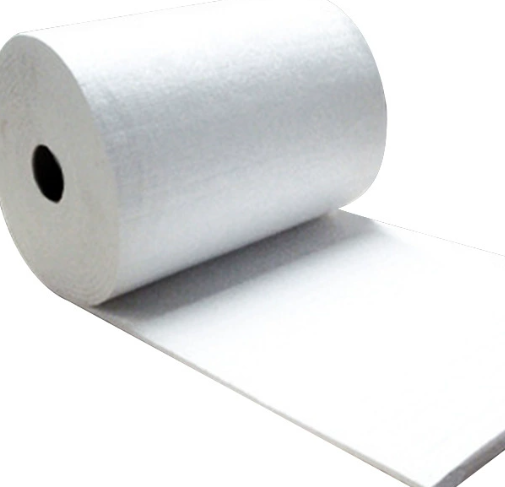
In the field of industrial fire protection, ceramic fiber cloth has become a critical protective material due to its excellent high-temperature resistance. The rationality of the sewing process directly impacts the performance of its fire-resistant properties. A scientifically standardized sewing process ensures that ceramic fiber cloth maintains structural integrity in high-temperature flame environments. Conversely, an improper sewing process may create fire-resistant weak points, leading to protective failure.
The selection of sewing thread is a foundational factor in determining the fire-resistant performance of ceramic fiber cloth. Ordinary cotton thread or synthetic fiber thread melts and burns at temperatures above 200°C, making them unsuitable for the high-temperature applications of ceramic fiber fabric. It is essential to use high-temperature-resistant sewing thread that matches the performance of ceramic fiber fabric, such as glass fiber thread or stainless steel metal thread. Among these, glass fiber sewing thread can withstand temperatures up to 800°C, while stainless steel metal thread can withstand temperatures exceeding 1000°C. Test data shows that ceramic fiber cloth sewn with stainless steel thread remains intact after being exposed to an 800°C flame for 30 minutes, while samples using synthetic fiber thread exhibit thread breakage within 15 minutes, causing the ceramic fiber cloth to split.
Stitch density and spacing significantly affect fire resistance performance. Sparse stitching can result in large gaps at the seams of the ceramic fiber fabric, allowing flames to penetrate through the gaps; overly dense stitching can damage the fiber structure due to excessive punctures, reducing local high-temperature strength. The ideal stitch density is 3–4 stitches per centimeter, with spacing uniformly controlled at 2–3 mm. Experiments show that under these parameters, the heat loss rate through stitching in ceramic fiber cloth exposed to flame impact is only 5%, far lower than the 15% loss rate of samples with sparse stitching. Additionally, the stitching should use a backstitch method to ensure each joint is reinforced with double stitching, enhancing tear resistance at high temperatures.
The design of the seam construction directly affects the integrity of the fire barrier. The overlap width of the ceramic fiber fabric must be no less than 50 mm, using a “multi-layer stacking + edge-sewing” process to avoid straight-line gaps formed by single-layer butt joints. When joining irregularly shaped sections, rounded corners should be used to reduce stress concentration and prevent seam rupture. Comparative testing shows that ceramic fiber cloth with overlapping seams maintains overall fire resistance for 90 minutes at 1000°C, while samples with butt seams only last 45 minutes, with noticeable flame penetration at the seams.
Edge treatment after sewing is equally important. The raw edges of ceramic fiber fabric must be hemmed with a seam width of no less than 10 mm to prevent fiber shedding at high temperatures, which could impair fire resistance. For areas subject to frequent friction, ceramic fiber fabric reinforcement strips can be added after sewing and secured with double stitching to enhance local abrasion resistance and fire stability.
In summary, a reasonable sewing process that optimizes thread material, stitch parameters, and joining methods can maximize the fire-resistant performance of ceramic fiber cloth, providing reliable protection for industrial high-temperature environments.