Oil leaks from vehicle half-shaft oil seals occur from time to time; fitting a ceramic fibre paper half-shaft heat shield can resolve this issue, which is why such heat shields are widely used in vehicles. Ceramic fibre paper half-shaft heat shields feature a sandwich structure, offering superior thermal insulation.
Material Analysis
There are two types of material used for heat shields: one is aluminium-coated sheet, which possesses strong resistance to chemical corrosion. The other is corrugated aluminium sheet, which offers similar performance to aluminium-coated sheet. As the automotive industry is moving towards lighter-weight designs, corrugated aluminium sheet is now the material of choice.
Early heat shields consisted of two layers of aluminium-coated sheet with a layer of asbestos in between; however, as asbestos is harmful to human health, it has been classified as a banned substance. Currently, the insulating material in the centre of these sandwich-structured heat shields is ceramic fibre paper, which is characterised by its light weight, fire resistance, high-temperature resistance, thermal insulation and soundproofing properties. It is available in two temperature-resistant grades—1,260 °C and 1,400 °C—and possesses a low thermal conductivity, thereby providing excellent thermal insulation.
Structural Analysis
Heat shield structures are categorised into two types based on the temperature of the surrounding heat sources: (1) single-layer structure; (2) sandwich structure. Single-layer heat shields are used where the heat source temperature is relatively low. Corrugated aluminium sheet is selected for its ease of forming; the material’s high-temperature resistance, heat reflectivity and corrosion resistance are sufficient to meet thermal insulation requirements. Furthermore, the heat-reflective surface area of corrugated aluminium sheet is significantly larger than that of flat aluminium sheet, resulting in superior performance. Heat sources near the half-shaft, such as the three-way catalytic converter and the exhaust pipe, reach very high temperatures; consequently, the half-shaft heat shield employs a sandwich structure with ceramic fibre paper as the insulating material in the middle (Figure 1), which provides superior thermal insulation.
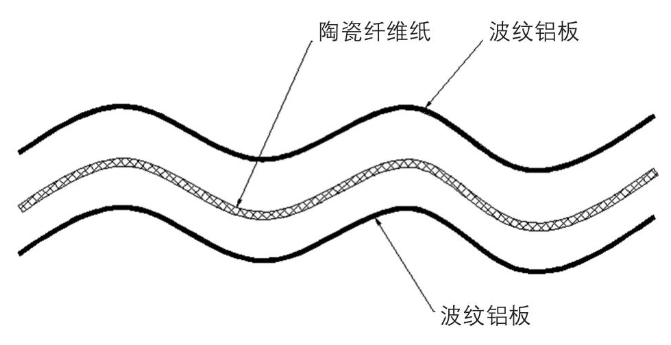
Sandwich structure, materials: two layers of corrugated aluminium sheet (t = 0.5 mm), with a corrugation height of 2.5 (±0.5) mm, and a 6 mm-thick layer of ceramic fibre paper in the middle.
Stamping Process
Shearing on a shearing machine — blanking of outer layer — blanking of inner layer — blanking of ceramic fibre paper — 90° flanging of outer layer — 45° flanging of outer layer — lamination of three layers — forming — punching on the side.
Stamping Die Design
Blanking Die Design
⑴ Calculation of blanking force: F_(blanking) = 1.3Ltτ; according to the formula, F_(blanking) = 5t.
(2) Selection of punch-die clearance: Material thickness t = 0.5 mm; based on the material thickness of aluminium, the double-sided clearance is 0.02–0.03 mm.
(3) Equipment selection: A 40t punch press is selected based on the die requirements and the magnitude of the blanking force.
(4) Die guidance selection: As the clearance between the punch and die is small, precision guide pins and bushings are selected for guidance.
(5) Die structure: There are two types: 1) bottom ejection; 2) top ejection. As aluminium sheet is relatively soft, the top ejection method is selected to prevent deformation.
Flanging Die Design
Points to note when designing 90° and 45° flanging dies: ⑴ Flanging clearance; if the clearance is too large and the flanging angle exceeds 90°, this will cause the flanges to overlap during the subsequent 45° flanging operation; if the clearance is too small, the aluminium sheet is likely to be sheared; for a base material thickness of 0.5 mm, the flanging clearance should be set at 0.5–0.6 mm; the die must be manufactured with precision, otherwise the 90° flanging effect cannot be achieved. (2) Part positioning: Part positioning must ensure that the part fits into the positioning system without any play; this is essential to guarantee the uniqueness of the flange. Therefore, the 90° flange is positioned using a method that locates all edges. For the 45° flange, positioning is achieved using locating pins, with 1–2 pins required on each edge.
Compression Mould Design
The compression mould consists of a three-layer assembly, comprising inner and outer layers of corrugated aluminium sheet bonded to a central layer of ceramic fibre paper. The three layers are first assembled together, then positioned within the compression mould, where the 45° edge is flattened directly. Care must be taken to flatten only the edges and not the centre; the purpose of this is to ensure a large surface area for heat reflection, thereby maximising heat reflection and protecting the half-shaft.
Forming Die Design
Forming is a critical process for this component. As the part has an irregular shape, accurate forming requires precise positioning and sufficient holding force to prevent the part from shifting sideways during the process, which would result in inaccurate forming. Given the depth of the forming operation and the need for substantial holding force, hydraulic forming is employed, utilising the lower hydraulic cylinder of the press. The pressure of the hydraulic cylinder is adjusted to meet the required pressure specifications.
Punching Die Design
For the side punching die, both holes are punched simultaneously to ensure the accurate relative positioning of the two holes. Side punching utilises an oblique wedge mechanism to convert vertical motion into horizontal motion; this is a simple method of altering the direction of motion, and the components are generally available from standard parts suppliers. Alternatively, an oblique wedge mechanism may be fabricated in-house as required to ensure smooth sliding.
Furthermore, heat shields are used in many parts of a vehicle, such as exhaust heat shields and engine heat shields. These heat shields have relatively complex shapes; by utilising the ease of forming corrugated aluminium sheets and the excellent thermal insulation properties of ceramic fibre paper, the challenges of complex forming and multiple processing steps have been resolved. Consequently, the use of ceramic fibre paper and corrugated aluminium sheets not only addresses thermal insulation requirements but also improves efficiency, reduces processing costs, and meets the requirements for automotive lightweighting.