In industrial high-temperature protection and equipment insulation applications, ceramic fiber cloth exhibits excellent high-temperature resistance. However, pure ceramic fiber cloth possesses relatively low mechanical strength, making it prone to tearing and damage during installation and use. To enhance structural stability, composite reinforcement technology combining ceramic fiber cloth with metal wires has emerged as a critical solution. Systematic mechanical testing is essential for validating the effectiveness of this technology, providing scientific basis for selecting appropriate composite ceramic fiber cloth applications.
This test selected pure ceramic fiber cloth (control group) and two composite ceramic fiber cloth samples (Experimental Group 1: ceramic fiber cloth + stainless steel wire; Experimental Group 2: Ceramic fiber cloth + nickel-chromium alloy wire). All samples were standardized at 200mm × 50mm dimensions. Three core tests—tensile strength, tear resistance, and fold endurance—were conducted using equipment including an electronic universal testing machine and a tear resistance tester.
Tensile strength test results showed that the pure ceramic fiber cloth had an average tensile strength of 12 MPa, with fibers prone to breakage under tensile force. After combining ceramic fiber cloth with stainless steel wire in Experimental Group 1, tensile strength increased to 28 MPa—a 133% increase over the control group. The high strength of stainless steel wire effectively dispersed tensile forces, reducing fiber breakage in the ceramic fiber cloth. In Experimental Group 2, the composite ceramic fiber fabric incorporating nickel-chromium alloy wire achieved a tensile strength of 35 MPa. This alloy’s combination of high strength and flexibility resulted in more uniform deformation during stretching, preventing localized stress concentration damage.
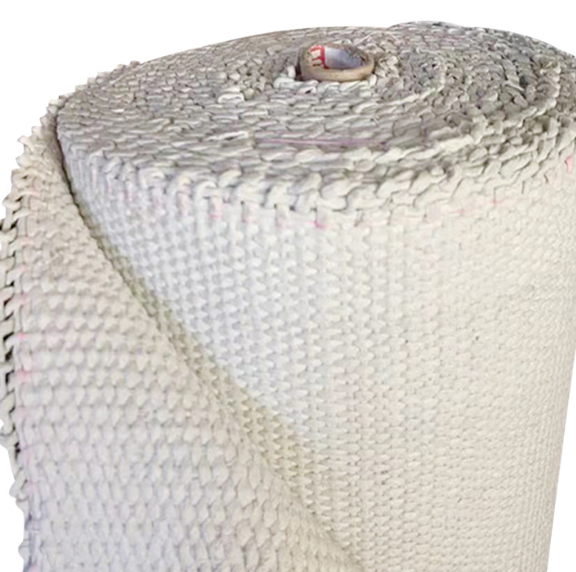
In tear strength testing, the pure ceramic fiber fabric exhibited an average tear strength of only 8N, with tears propagating rapidly after initiation. The composite fabric in Test Group 1 achieved a tear strength of 25N, as the stainless steel wires formed a “barrier layer” at tear fronts, slowing propagation speed. The composite ceramic fiber fabric in Test Group 2 exceeded 32 N in tear resistance. The tightly interwoven structure of nickel-chromium alloy wires with ceramic fibers required overcoming dual bonding forces between metal wires and fibers, significantly enhancing tear resistance. After testing, the tear edges remained relatively intact.
Fold resistance testing evaluated durability through repeated folding of samples (180° angle, 1 fold/second). Pure ceramic fiber fabric exhibited noticeable fiber shedding and surface pilling after 50 folds, with complete rupture occurring after 100 folds. The composite ceramic fiber fabric in Test Group 1 exhibited only minor fiber wear after 300 folds and maintained basic structural integrity after 500 folds. The composite ceramic fiber fabric in Test Group 2 demonstrated the best fold resistance, showing only localized fine cracks after 800 folds with no large-scale fiber detachment, exhibiting excellent fatigue resistance.
The comprehensive test results indicate that combining ceramic fiber fabric with metal wires significantly enhances its mechanical properties, with nickel-chromium alloy wires providing superior reinforcement compared to stainless steel wires. This conclusion provides data support for the application of composite ceramic fiber cloth in high-temperature scenarios. For instance, in environments demanding high mechanical performance—such as protective clothing in steel mills or high-temperature conveyor belts—materials combining ceramic fiber cloth with nickel-chromium alloy wire can significantly extend service life and reduce maintenance costs while ensuring high-temperature resistance.