For irregularly shaped insulation sections in industrial equipment (such as pipe elbows, kiln corners, cryogenic tank interfaces, etc.), the adaptability of custom-cut ceramic fiber boards directly impacts insulation effectiveness. Precision in cutting and processing is crucial for achieving this adaptability. Due to the brittle nature of ceramic fiber boards and the tendency of fibers to shed, custom cutting requires multi-stage precision control to ensure finished dimensions meet design tolerances. Key control points are outlined below.
Precise cutting begins with drawing analysis and material preparation. Based on the three-dimensional dimensions of the equipment’s irregular sections, create 1:1 scale cutting drawings that clearly define critical parameters such as arc radii, bevel angles, and hole locations. This prevents cutting deviations caused by drawing scale inaccuracies. Simultaneously, pre-treat the raw ceramic fiber board material: Select boards with uniform density (tolerance ≤2kg/m³) to prevent cutting force imbalance caused by density variations. Allow the boards to rest for 24 hours in a dry, ambient-temperature environment to eliminate internal stresses, preventing dimensional deformation due to stress release after cutting. For example, when cutting curved ceramic fiber boards for pipe elbows, pre-mark the arc’s center point and curvature value to ensure tight fit against the pipe’s outer wall after cutting.
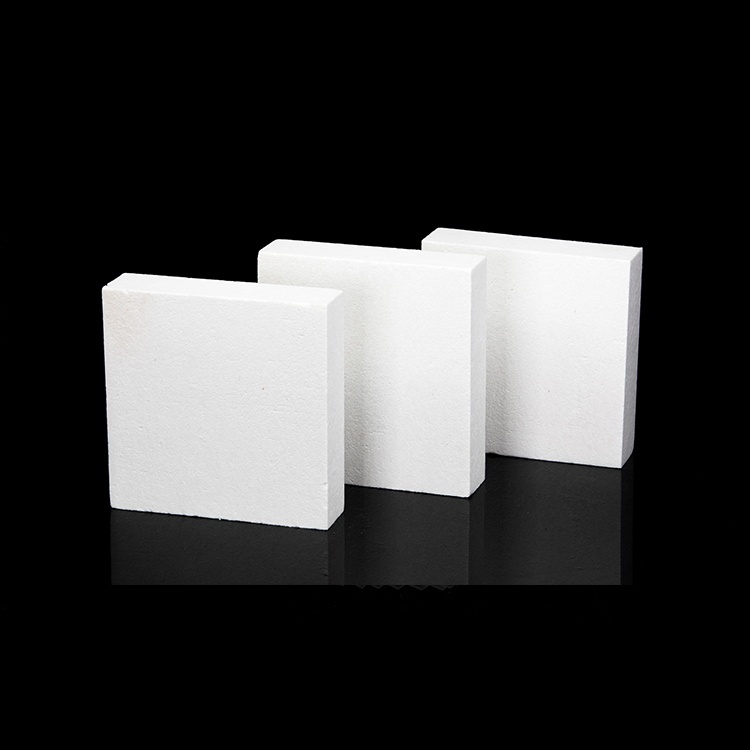
The selection of cutting equipment and tools directly impacts precision. Avoid traditional manual tools (e.g., utility knives) for cutting irregularly shaped ceramic fiber boards. Prioritize CNC waterjet cutters or laser cutters: CNC waterjet cutting employs high-pressure water (30-40MPa) with garnet abrasive to achieve thermal-free cutting of ceramic fiber boards, particularly suitable for irregular shapes exceeding 50mm thickness with precision up to ±0.1mm. Laser cutters are suitable for thin (≤20mm thick) irregularly shaped ceramic fiber boards. Adjusting laser power (80-120W) controls cutting speed (50-80mm/min), preventing edge carbonization caused by excessive power. Additionally, anti-slip rubber mats must be installed on the cutting platform to prevent board displacement during processing. Equipment guide rail parallelism requires regular calibration (error controlled within 0.05mm/m) to ensure precise cutting paths.
Precision control of cutting parameters is central to ensuring accuracy. Differentiated cutting strategies are applied for various irregular structures: When cutting arcs, set the CNC machine’s cutting step size below 0.5mm, achieving smooth curves through high-frequency, small-amplitude movements. For beveled edges or surfaces, adjust the cutting head angle relative to the ceramic fiber board to ensure slope deviation ≤0.5°. For cutting openings (e.g., bolt holes, inspection ports), first drill a positioning hole (3-5mm diameter) at the center. Gradually enlarge the aperture using this hole as the center to prevent positional deviation caused by direct drilling. Simultaneously, continuously clear ceramic fiber debris generated during cutting to prevent accumulation that could affect cutting depth. For example, when cutting 30mm-thick irregular ceramic fiber boards, pause every 10mm to clear debris, ensuring uniform cutting depth.
Post-cutting precision inspection and correction are critical. Use a digital vernier caliper (0.01mm accuracy) to measure key dimensions (e.g., arc length, bevel length, hole diameter) of the shaped ceramic fiber board, comparing against design drawings to calculate deviations. Employ a laser distance meter to verify flatness, ensuring planarity error on shaped surfaces ≤0.2mm/m. For minor deviations (≤0.3mm), gently sand with fine-grit sandpaper (800 grit or higher) to correct, avoiding excessive sanding that could cause dimensional overshoot. Deviations exceeding 0.5mm require recutting to prevent non-conforming products from affecting subsequent installation.
By implementing these precision control measures, cutting deviations for irregularly shaped ceramic fiber boards can be maintained within ±0.3mm. This ensures perfect fitment with equipment contours, maximizes thermal insulation performance, and safeguards stable operation of industrial equipment.