In today’s era of rapid technological advancement, materials science continues to push the boundaries, opening up possibilities for applications in a wide range of extreme environments. Ceramic fibre paper, as a new material with excellent properties, is gradually moving from the laboratory onto a broader stage; it has demonstrated extraordinary potential, particularly in the aerospace sector, where material requirements are extremely demanding. Today, Mu Yi will delve into the characteristics of ceramic fibre paper, its manufacturing processes, and how it withstands extreme environments, presenting readers with a comprehensive ‘Survival Guide for Extreme Environments’.
Characteristics of Ceramic Fibre Paper
High-Temperature Stability
Ceramic fibre paper is primarily made from ceramic fibres, which possess an extremely high melting point, enabling the material to maintain stable physical and chemical properties in high-temperature environments. In spacecraft, when faced with high-temperature areas such as engine combustion chambers and thermal protection systems, ceramic fibre paper can effectively insulate against heat, protecting critical components from high-temperature damage.
Low Thermal Conductivity
Ceramic fibre paper possesses extremely low thermal conductivity, meaning it can effectively prevent the transfer of heat. In spacecraft thermal insulation systems, the use of ceramic fibre paper reduces heat loss, improves energy efficiency, and helps maintain a stable internal temperature.
Chemical Stability
Ceramic fibre paper exhibits good resistance to most chemical substances and is not prone to chemical reactions. In the complex environment of a spacecraft, where various corrosive substances may be encountered, the chemical stability of ceramic fibre paper ensures that it maintains stable performance over the long term under these harsh conditions.
Flexibility and Workability
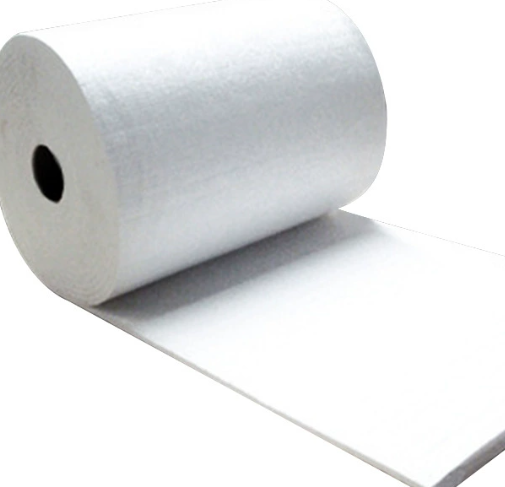
Although ceramic fibre paper possesses high strength and high modulus, it also exhibits good flexibility and workability. This enables it to be fabricated into products of various shapes and sizes to meet the requirements of different spacecraft components. Whether used as a thermal insulation layer, a protective layer or a structural material, ceramic fibre paper demonstrates its advantages.
Manufacturing Process
Raw Material Selection
The primary raw material for the production of ceramic fibre paper is ceramic fibre, which can be produced using methods such as melt spinning and solution spinning. The selection of raw materials has a crucial impact on the performance of ceramic fibre paper; therefore, the purity and quality of the raw materials must be strictly controlled.
Forming Process
Forming is one of the key steps in the preparation of ceramic fibre paper. Common forming methods include wet forming and dry forming. Wet forming involves dispersing ceramic fibres in water to form a uniform suspension, which is then processed into paper through filtration, pressing and other processes. Dry forming, on the other hand, involves directly laying out the ceramic fibres into a mesh-like structure, which is then bonded into paper using methods such as hot pressing.
Post-processing
Once formed, ceramic fibre paper requires post-processing to enhance its performance. Post-processing techniques include high-temperature sintering and surface treatment. High-temperature sintering creates a tighter bond between the ceramic fibres, improving the paper’s strength and stability. Surface treatment, meanwhile, enhances the surface properties of the ceramic fibre paper, increasing its corrosion resistance and wear resistance.
Survival Strategies in Extreme Environments
High-Temperature Environments
In high-temperature environments, the thermal stability and low thermal conductivity of ceramic fibre paper make it an ideal thermal insulation material. In the thermal protection systems of spacecraft, ceramic fibre paper can effectively block high-temperature airflow and thermal radiation, protecting the spacecraft’s internal structure from damage. At the same time, its excellent flexibility enables it to adapt to a wide range of complex shapes and dimensional requirements.
Low-Temperature Environments
In low-temperature environments, the flexibility and chemical stability of ceramic fibre paper are equally beneficial. It can serve as thermal insulation for spacecraft, preventing heat loss and maintaining a stable internal temperature. Furthermore, ceramic fibre paper can be used to manufacture cryogenic seals and thermal insulation layers, ensuring the normal operation of spacecraft in low-temperature conditions.
Radiation Environments
During the operation of spacecraft, they may encounter various radiation environments, such as cosmic rays and the solar wind. Ceramic fibre paper possesses a certain degree of radiation resistance and can withstand radiation damage to a limited extent. However, in extreme radiation environments, additional protective measures are required to ensure the stable performance of the ceramic fibre paper.
Vacuum Environments
In vacuum environments, the low thermal conductivity and chemical stability of ceramic fibre paper make it an ideal thermal insulation and protective material. It can be used to manufacture vacuum insulation layers for spacecraft, preventing heat transfer via thermal radiation. At the same time, its excellent flexibility enables it to adapt to the various deformation and stress requirements encountered in vacuum environments.
Application Examples
Spacecraft Thermal Protection Systems
In spacecraft thermal protection systems, ceramic fibre paper is widely used in thermal insulation and protective layers. For example, on the wings and fuselage surfaces of space shuttles, thermal insulation layers made from ceramic fibre paper can effectively block high-temperature airflow and thermal radiation, protecting the internal structure of the space shuttle from damage.
Survival Strategies in Extreme Environments
High-Temperature Environments
In high-temperature environments, the high-temperature stability and low thermal conductivity of ceramic fibre paper make it an ideal thermal insulation material. In the thermal protection systems of spacecraft, ceramic fibre paper can effectively block high-temperature airflow and thermal radiation, protecting the spacecraft’s internal structure from damage. At the same time, its excellent flexibility enables it to adapt to a wide range of complex shapes and dimensional requirements.
Low-Temperature Environments
In low-temperature environments, the flexibility and chemical stability of ceramic fibre paper are equally beneficial. It can serve as thermal insulation for spacecraft, preventing heat loss and maintaining a stable internal temperature. Furthermore, ceramic fibre paper can be used to manufacture cryogenic seals and thermal insulation layers, ensuring the normal operation of spacecraft in low-temperature conditions.
Radiation Environments
During the operation of spacecraft, they may encounter various radiation environments, such as cosmic rays and the solar wind. Ceramic fibre paper possesses a certain degree of radiation resistance and can withstand radiation damage to a limited extent. However, in extreme radiation environments, additional protective measures are required to ensure the stable performance of the ceramic fibre paper.
Vacuum Environments
In vacuum environments, the low thermal conductivity and chemical stability of ceramic fibre paper make it an ideal thermal insulation and protective material. It can be used to manufacture vacuum insulation layers for spacecraft, preventing heat transfer via thermal radiation. At the same time, its excellent flexibility enables it to adapt to the various deformation and stress requirements encountered in vacuum environments.
Application Examples
Spacecraft Thermal Protection Systems
In spacecraft thermal protection systems, ceramic fibre paper is widely used in thermal insulation and protective layers. For example, on the wings and fuselage surfaces of space shuttles, thermal insulation layers made from ceramic fibre paper can effectively block high-temperature airflow and thermal radiation, protecting the internal structure of the space shuttle from damage.
Satellite Thermal Insulation Materials
Ceramic fibre paper is also utilised as a thermal insulation material on satellites. Whilst in orbit, satellites are exposed to high-temperature environments caused by solar radiation and reflected radiation from the Earth; the use of ceramic fibre paper effectively reduces the internal temperature of the satellite, thereby enhancing its performance and service life.
Conclusion
From the laboratory to spacecraft, ceramic fibre paper, with its excellent properties and broad application prospects, is gradually becoming the ideal material for extreme environments. With continuous technological progress and the ongoing optimisation of manufacturing processes, the performance of ceramic fibre paper will be further enhanced, and its applications in fields such as spacecraft will become even more widespread and in-depth. In the future, we have every reason to believe that ceramic fibre paper will play an even more important role in the journey of exploring the universe, making greater contributions to humanity’s space programme.