In industrial high-temperature applications, the relationship between the tensile strength of ceramic fiber cloth and temperature is of great concern, as it directly affects its applicability and reliability under different operating conditions. Data obtained through rigorous experiments can clearly demonstrate the performance of ceramic fiber cloth under varying temperatures.
The experiments utilized ceramic fiber cloth of various specifications, including standard-type and high-purity-type, to test their tensile strength across different temperature ranges. The experimental equipment employed a high-precision universal material testing machine, capable of precisely applying tensile force and recording the values at the point of fracture, ensuring data accuracy. The temperature environment was simulated using a high-temperature furnace, enabling stable control of temperature from ambient conditions up to 1400°C, with constant temperature maintenance to observe changes in the performance of the ceramic fiber cloth.
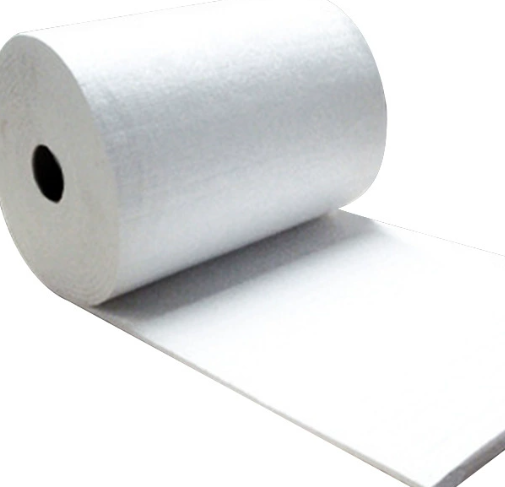
The experimental data showed that the tensile strength of ceramic fiber cloth was excellent at room temperature, with standard-type ceramic fiber cloth reaching 20–30 MPa and high-purity-type reaching approximately 30–40 MPa. This was due to the tightly woven structure between the fibers and the high strength of the fibers themselves, enabling them to withstand significant tensile forces in their initial state.
As the temperature gradually increases to 800°C, the tensile strength of the ceramic fiber fabric shows a slow decline, with the standard type decreasing to 15–20 MPa and the high-purity type to 20–25 MPa. At this point, the crystal structure within the fibers begins to undergo subtle changes, but the overall structure still maintains good mechanical properties, meeting the strength requirements of most medium-to-high-temperature industrial applications, such as insulation linings for industrial furnaces and high-temperature pipe insulation.
When the temperature rises to 1200°C, the tensile strength of standard-type ceramic fiber cloth stabilizes at 10–15 MPa, while high-purity type remains between 15–20 MPa. Although the strength decreases, it still maintains good toughness and integrity, and does not easily break under tension. A study indicates that after continuous use at 1200°C for 1000 hours, the tensile strength of ceramic fiber cloth decreases by only 10–15%, demonstrating its excellent stability in high-temperature environments.
However, when temperatures approach 1400°C, some ceramic fiber cloth exhibits performance changes. The tensile strength of ordinary ceramic fiber cloth drops sharply, even below 10 MPa, and the fiber structure becomes brittle, with severe loss of toughness; however, high-purity ceramic fiber cloth prepared using special processes can still maintain a tensile strength of 10–15 MPa, demonstrating excellent high-temperature resistance and suitability for extreme conditions such as ultra-high-temperature metallurgy and glass melting.
Based on comprehensive experimental data, ceramic fiber cloth maintains a high and stable tensile strength in the medium-to-high temperature range (800°C to 1200°C), meeting the requirements of most industrial applications. In ultra-high-temperature environments, high-purity ceramic fiber cloth ensures safe use in extreme conditions thanks to its outstanding high-temperature resistance. These experimental data provide critical reference for industrial users when selecting ceramic fiber cloth, enabling precise product matching based on actual temperature conditions to fully leverage the performance advantages of ceramic fiber cloth and enhance the stability and reliability of industrial equipment operation.