In the industrial insulation materials market, ceramic fiber blankets and glass fiber blankets are two commonly used products, each with distinct performance characteristics and application scenarios. A comprehensive comparison can help businesses select the appropriate product based on their specific needs, thereby maximizing the material’s performance.
In terms of high-temperature resistance, ceramic fiber blankets offer significant advantages. Ceramic fiber blankets can withstand long-term temperatures of 1000°C to 1400°C and can tolerate even higher temperatures for short periods, making them suitable for high-temperature environments such as industrial furnaces and metallurgical furnaces. In contrast, glass fiber blankets have weaker high-temperature resistance, with long-term operating temperatures typically not exceeding 500°C. Exceeding this temperature can cause softening, shrinkage, or even loss of insulation performance, making them more suitable for medium-to-low-temperature insulation applications.
In terms of high-temperature resistance, ceramic fiber blankets offer significant advantages. Ceramic fiber blankets can withstand long-term temperatures of 1000°C to 1400°C and can tolerate even higher temperatures for short periods, making them suitable for high-temperature environments such as industrial furnaces and metallurgical furnaces. In contrast, glass fiber blankets have weaker high-temperature resistance, with long-term operating temperatures typically not exceeding 500°C. Exceeding this temperature can cause softening, shrinkage, or even loss of insulation performance, making them more suitable for medium-to-low-temperature insulation applications.
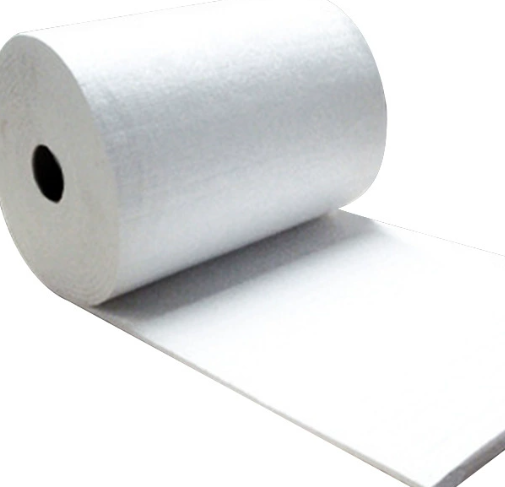
In terms of thermal insulation performance, ceramic fiber blankets and glass fiber blankets each have their own characteristics. Ceramic fiber blankets have a dense internal fiber structure with high porosity, maintaining a low thermal conductivity coefficient even at high temperatures, ensuring stable and long-lasting thermal insulation performance. Glass fiber blankets exhibit excellent thermal insulation performance at room temperature, but their insulation effectiveness decreases significantly as temperature rises, particularly in environments above 200°C, where heat loss rates are notably higher than those of ceramic fiber blankets.
In terms of mechanical strength and durability, glass fiber blankets have a slight advantage. The fibers in glass fiber blankets are highly resilient, with good tensile and tear resistance, making them less prone to damage during handling and installation. Ceramic fiber blankets have brittle fibers. Although their overall structure has some elasticity, they are prone to fiber shedding when subjected to severe impacts or frequent friction, requiring extra care during construction. However, ceramic fiber blankets have superior thermal shock resistance, are less prone to cracking during sudden temperature changes, and have a longer service life.
In terms of chemical stability, ceramic fiber blankets perform better. They exhibit good corrosion resistance to acidic and alkaline media and are unlikely to react with chemicals in industrial environments. Glass fiber blankets, however, are sensitive to strong alkalis and may corrode upon prolonged contact, leading to structural damage. Therefore, ceramic fiber blankets are more suitable for corrosive environments such as chemical plants.
The differences in application scenarios are also quite evident. Ceramic fiber blankets are widely used for thermal insulation in high-temperature industrial equipment such as boilers, cracking furnaces, and high-temperature pipelines. Glass fiber blankets are primarily used in building insulation, low-temperature pipeline insulation, and appliance insulation in medium-to-low-temperature applications. Additionally, in terms of environmental friendliness, both are inorganic fiber materials with minimal environmental impact when discarded, but ceramic fiber blankets have higher recyclability and reusability value.
In summary, ceramic fiber blankets have advantages in high-temperature resistance, high-temperature insulation, and chemical stability, making them suitable for high-temperature complex environments. Glass fiber blankets perform better in terms of room-temperature insulation and mechanical strength, making them suitable for medium-to-low-temperature applications. Companies should select the appropriate material based on actual operating conditions to achieve optimal insulation performance and cost control.