As a new type of high-temperature thermal insulation material, ceramic fibre cloth is widely used in sectors such as metallurgy, chemical engineering, power generation and aerospace, owing to its lightweight nature, high-temperature resistance and low thermal conductivity. One of its key advantages lies in its excellent chemical stability, with particularly outstanding performance in resisting acid and alkali corrosion. Today, Mu Yi will provide a systematic analysis of the classification of ceramic fibre cloth’s resistance to acid and alkali corrosion, as well as the underlying technical principles, drawing on industry testing standards and practical application scenarios.
I. Chemical Composition and Fundamentals of Corrosion Resistance in Ceramic Fibre Cloth
Ceramic fibre cloth consists primarily of aluminium oxide (Al₂O₃) and silicon dioxide (SiO₂), with some products containing stabilisers such as zirconium oxide (ZrO₂) and yttrium oxide (Y₂O₃). This inorganic oxide structure confers natural chemical inertness:
Acid resistance: It exhibits high stability against strong acids such as sulphuric acid and hydrochloric acid (with the exception of hydrofluoric acid). For example, after 72 hours of immersion in an acidic environment with a pH of 2, high-purity aluminosilicate fibre cloth exhibits a mass loss rate of less than 0.5 per cent, with no visible signs of corrosion on the surface.
Alkali resistance: In an alkaline solution with a pH of 12, zirconia-containing ceramic fibre cloth demonstrates superior corrosion resistance compared to standard aluminosilicate fibres. Experimental data show that its corrosion rate is only 0.02 mm/year, which is far below the industry standard requirement of 0.1 mm/year.
II. Classification Standards for Acid and Alkali Corrosion Resistance
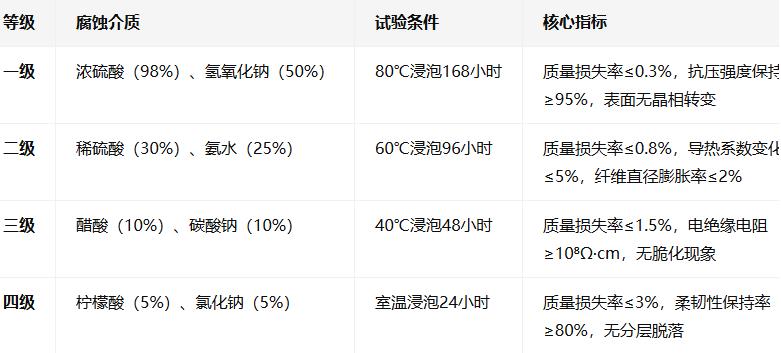
In accordance with the International Federation of Refractories (IFRF) and the Chinese National Standard (GB/T 3003-2017), the corrosion resistance grade of ceramic fibre cloth is comprehensively assessed through immersion testing and performance degradation rates, and is classified into the following four grades:
Technical Principle:
The corrosion resistance grade is closely related to the Al₂O₃/SiO₂ ratio in the fibres. For example, mullite fibres (Al₂O₃ content 72%–75%) maintain their performance even in Grade 1 corrosive environments due to their stable crystal structure; whereas ordinary alumina-silicate fibres may experience a decline in strength under the same conditions due to the leaching of SiO₂.
III. Typical Application Scenarios and Grade Matching
Chemical Industry:
Reactor Sealing: Grade 1 corrosion-resistant fibre cloth is required to withstand highly corrosive media such as concentrated sulphuric acid and sodium hydroxide. For example, a petrochemical enterprise utilised zirconia-containing ceramic fibre cloth to seal a hydrofluoric acid reactor, achieving a service life of over five years—a threefold increase compared to traditional asbestos materials.
Pipe lining: Grade 2 fibre cloth is suitable for pipes transporting dilute acids and alkaline solutions. For instance, a paper mill used this grade of material to line its cooking liquor pipes, reducing the annual corrosion loss rate from 0.5 mm to 0.1 mm.
Metallurgical Industry:
High-temperature furnace door curtains: Grade 3 fibre cloth can withstand weakly acidic gases generated by molten metal splashes. Following its implementation at a steelworks, the frequency of furnace door maintenance was reduced by 60 per cent.
Electric furnace dust collectors: Grade 4 fibre cloth is used to filter dust-laden gases; it maintains structural integrity even in humid environments, with filtration efficiency remaining stable at over 99 per cent.
New energy sector:
Lithium-ion battery separator substrate: Grade 1 corrosion-resistant fibre cloth is required to prevent erosion by the electrolyte (containing lithium hexafluorophosphate). Experiments have shown that its corrosion resistance is more than 10 times that of polypropylene separators.
IV. Technical Approaches to Enhancing Corrosion Resistance
Material Modification:
Atomic Layer Deposition (ALD): Depositing a 5–10 nm layer of aluminium oxide nanoparticles onto the fibre surface increases dye adsorption by 30 per cent whilst enhancing resistance to acids and alkalis. Following the adoption of this technology by a certain enterprise, the service life of the fibre fabric when immersed in hydrochloric acid at pH = 1 was extended from 72 hours to 500 hours.
Elemental Doping: The addition of 0.5–2 per cent zirconia (ZrO₂) can suppress phase transformations. For example, ZrO₂-doped mullite fibres remain structurally stable even at high temperatures of 1,600 °C.
Structural Optimisation:
Three-dimensional Weaving Technology: By dispersing stress through a multi-layered interwoven structure, the tear strength of the fibre fabric in corrosive environments is increased by 40 per cent. Following the adoption of this technology by a certain aeroengine manufacturer, the service life of the turbine insulation layer was extended to 8,000 hours.
Composite coating: Spraying a silica sol–aluminium oxide composite coating forms a dense protective layer. Experiments show that the corrosion rate of coated fibre cloth in a 10 per cent sodium hydroxide solution is reduced to 0.005 mm/year.
V. Testing and Certification System
International Standards:
ASTM C1617 ‘Test Method for Chemical Resistance of Ceramic Fibres’
ISO 12665 ‘Classification of Refractory Materials for Resistance to Acid and Alkali Corrosion’
National Standards:
GB/T 3003-2017 ‘Test Method for Chemical Corrosion Resistance of Ceramic Fibre Products’
YB/T 4130-2018 ‘Test Method for Alkali Corrosion Resistance of Refractory Materials’
Certification Bodies:
China National Quality Supervision and Inspection Centre for Refractory Materials
SGS Standard Technical Services Co., Ltd.
VI. Future Development Trends
As the performance requirements for materials in high-end manufacturing sectors such as new energy and semiconductors continue to rise, corrosion-resistant technology for ceramic fibre cloth will evolve in the following directions:
Materials with low corrosion rates: Development of fibre cloth with a corrosion rate of ≤0.001 mm/year to meet the requirements of semiconductor wafer manufacturing environments.
Smart responsive coatings: Research and development of pH-sensitive self-healing coatings that automatically release inhibitors at the onset of corrosion to extend the service life of the material.
Green manufacturing processes: Adopting water-based sol-gel methods to replace organic solvents, thereby reducing VOC emissions during production.
Conclusion
The acid and alkali corrosion resistance of ceramic fibre cloth is one of its core competitive advantages. Through material modification, structural optimisation and rigorous testing and certification, it is now capable of meeting diverse requirements ranging from conventional industrial applications to complex environments. As technology evolves, this material will deliver greater value in the high-end manufacturing sector, driving the industry’s transition towards greener and more efficient practices.