In the petrochemical industry, high-temperature piping systems serve as the ‘industrial arteries’ connecting core equipment such as cracking furnaces, distillation columns and reactors; their operating temperatures often reach 800–1,200 °C, with pressure fluctuations ranging from 0.1 to 10 MPa. Under such operating conditions, traditional insulation materials such as calcium silicate boards and rock wool are prone to thermal shock cracking, powdering and spalling, leading to excessive surface temperatures on the pipelines, a sharp rise in energy consumption, and even leakage incidents. By introducing zirconia-aluminium ceramic fibre paper, a refining and petrochemical enterprise in Shandong successfully reduced the surface temperature of the main steam pipeline in its ethylene cracking unit from 320°C to 150°C, saving 23,000 tonnes of fuel oil annually whilst reducing thermal stress on the pipeline by 65 per cent, thereby providing an innovative solution for the safe operation of high-temperature pipelines in the industry.
I. Technical Breakthroughs: The Thermal Insulation Mechanism and Material Innovations of Ceramic Fibre Paper
1. Nano-scale fibre network forms a thermal resistance barrier
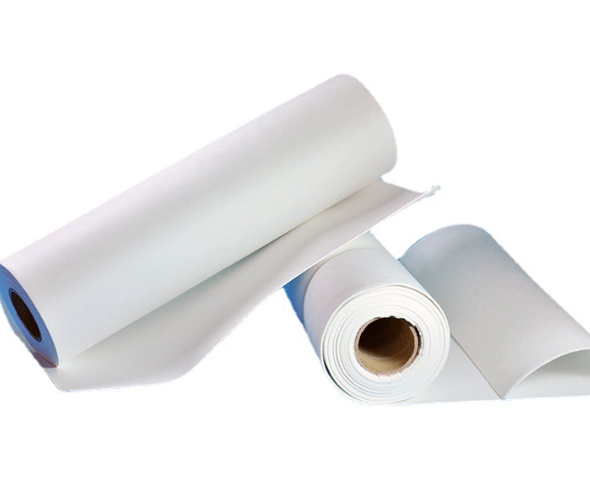
Ceramic fibre paper uses an aluminium oxide–silicon dioxide matrix and employs a spinning process to form a fibre network with a diameter of 3–5 μm, featuring an internal porosity of over 95 per cent. Its thermal insulation performance stems from three mechanisms:
Inhibition of fibre-based heat conduction: With a fibre diameter 40 per cent smaller than that of conventional alumina-silica fibres, the solid heat conduction path is extended by a factor of 20, resulting in a thermal conductivity of just 0.18 W/(m·K) at 1,000 °C
Enhanced vapour-phase barrier: Nanoscale pores (pore size < 100 nm) restrict the movement of gas molecules, reducing the proportion of vapour-phase heat transfer from 60 per cent in conventional materials to 25 per cent
Radiant heat reflection: Following the application of an infrared-reflective coating to the surface, radiant heat transfer is reduced by 78 per cent at 1,000 °C, making it particularly suitable for high-temperature radiant environments
2. Zirconia-aluminium composite system breaks through temperature resistance limits
For high-temperature pipelines operating at 1050°C in petrochemical plants, electrofused aluminium oxide–zirconia composite fibre technology is employed:
Phase-transition toughening: Zirconia (18 wt%) undergoes a tetragonal-to-monoclinic phase transition at high temperatures, absorbing thermal stress and preventing crack propagation, thereby maintaining the material’s tensile strength at 0.3 MPa even at 1200°C
Optimised creep resistance: Through whisker orientation technology, the creep rate at 1,000 °C over 100 hours has been reduced from 1.2 per cent for conventional materials to 0.15 per cent
Enhanced corrosion resistance: A surface coating of yttrium-stabilised zirconia (YSZ) reduces the corrosion rate in sulphur-containing flue gas to 0.02 mm/year, which is only one-tenth that of calcium silicate boards
II. Engineering Practice: Full-Scene Applications from Ethylene Cracking to Hydrogenation Units
1. Retrofitting of Piping in the Radiation Section of an Ethylene Cracker
In an 800,000-metric-tonne-per-year ethylene plant at a certain petrochemical enterprise, a retrofitting case study of the main steam pipeline (design temperature 1,150°C) demonstrated:
Structural Innovation: Adoption of a composite structure comprising ‘ceramic fibre paper + stainless steel wire mesh + high-temperature-resistant mortar’ reduced the insulation layer thickness from 200 mm to 80 mm
Thermal Optimisation: The pipe surface temperature was reduced from 320°C to 150°C, resulting in a 58 per cent reduction in heat loss during steam transport and annual fuel oil savings of 23,000 tonnes
Safety Enhancement: Infrared thermal imaging monitoring revealed that, following the retrofit, peak thermal stress on the pipes fell from 220 MPa to 75 MPa, extending fatigue life by a factor of three
2. Protection of the outlet pipeline for the hydrogenation reactor
In the diesel hydrogenation unit (reaction temperature 420 °C, pressure 8.5 MPa), ceramic fibre paper is used for insulation of expansion joints:
Dynamic sealing: Corrugated fibre paper modules (corrugation height 5 mm, pitch 15 mm) were developed; when used in conjunction with graphite packing, they achieve zero leakage under axial displacement of ±15 mm
Hydrogen embrittlement prevention design: Through surface nickel plating, the hydrogen permeability of the fibre paper in a hydrogen-rich environment was reduced to 10⁻¹² mol/(m²·s·Pa), preventing hydrogen embrittlement of the pipeline substrate
Economic benefits: Following the retrofit, heat loss from the pipeline was reduced by 45 per cent, the shutdown maintenance cycle was extended from 18 months to 36 months, and annual maintenance costs were reduced by 8 million yuan
3. Flue insulation for the regenerator in a catalytic cracking unit
In a heavy oil catalytic cracking unit (flue gas temperature 850 °C), ceramic fibre paper is applied to the flue elbows:
Erosion-resistant structure: Using a fibre paper and ceramic pin anchoring system, the erosion resistance lifespan reaches 5 years at a flue gas velocity of 15 m/s, which is three times that of castable refractories
Energy efficiency improvements: The temperature of the flue’s outer wall was reduced from 280 °C to 110 °C, increasing flue gas waste heat recovery efficiency by 12 per cent and boosting annual steam production by 12,000 metric tonnes
Environmental benefits: By lowering the surface temperature, fugitive VOC emissions from the flue were reduced by 65 per cent, meeting the requirements of the ‘Emission Standards for Pollutants in the Petroleum Refining Industry’
III. Construction Innovations: Modular Installation and Intelligent Monitoring Systems
1. 3D Folded Module Technology
Development of ceramic fibre folded modules specifically designed for petrochemical pipelines:
Dimensional accuracy: Module dimensional tolerances are controlled to within ±1 mm, ensuring 100% conformity with the pipeline and eliminating thermal bridges caused by overlaps in traditional layered installation methods
Rapid installation: The use of a ‘sliding rail’ anchoring system reduces the insulation installation time for a single DN800 pipeline from 72 hours to 18 hours
Seismic-Resistant Design: A 2 mm elastic gap is left between modules; combined with silicone sealing strips, the system withstood 100,000 fatigue vibration cycles without structural damage
2. Hot-State Monitoring IoT System
Distributed optical fibre sensors embedded within the fibre paper insulation layer:
Real-Time Temperature Measurement: Temperature measurement points are arranged at 0.5 m intervals, enabling three-dimensional imaging of the full circumferential temperature field of the pipeline, with an accuracy of ±1 °C
Leak early warning: By monitoring changes in hydrogen concentration within the insulation layer, alarms can be triggered within 30 seconds of a leak occurring, representing a 200-fold improvement in response speed compared to manual inspections
Lifespan prediction: Based on machine learning algorithms, the ageing trends of the fibre paper are predicted using historical data, limiting the margin of error in maintenance windows to ±7 days
IV. Economic and Environmental Benefits: Optimisation from Individual Units to the Entire Plant
1. Full Life-Cycle Cost Analysis
Taking a 500,000-metric-tonne-per-year aromatics unit at a certain refining and petrochemical plant as an example:
Return on Investment: The initial investment for the ceramic fibre paper solution is 35 per cent higher than that for the rock wool solution; however, with annual fuel oil savings of 18,000 metric tonnes, the payback period is only 1.8 years
Maintenance Costs: Over a 10-year operating cycle, maintenance costs for the fibre paper solution are only 23 per cent of those for the rock wool solution, with a 90 per cent reduction in the number of shutdowns caused by pulverisation
Carbon Emissions Reduction: Reduces the unit’s comprehensive energy consumption from 68 kgce/t to 59 kgce/t, cutting annual carbon emissions by 42,000 tonnes and meeting the requirements of the EU Carbon Border Adjustment Mechanism (CBAM)
2. Breakthroughs in Policy Compliance
The application of ceramic fibre paper helps enterprises meet the following requirements:
Safety Standards: Complies with the requirement for high-temperature pipeline surface temperatures to be <150°C, as stipulated in the ‘Fire Protection Design Standards for Petrochemical Enterprises’ (GB50160-2018)
Energy Efficiency Certification: Passed the Ministry of Industry and Information Technology’s certification for ‘Energy Efficiency Benchmark and Baseline Levels in Key Sectors of Energy-Intensive Industries’, thereby qualifying for preferential green credit schemes
Environmental Regulations: Achieved VOC concentrations at plant boundaries of <0.6 mg/m³, as required by the ‘Standard for Control of Fugitive Emissions of Volatile Organic Compounds’ (GB37822-2019)
V. Future Outlook: Integration of Materials Genome Engineering and Smart Operation and Maintenance
Currently, ceramic fibre paper technology is undergoing deep integration with materials genome engineering:
1. Composition optimisation: Through high-throughput computational screening, the composition ratio of the Al₂O₃-SiO₂-ZrO₂-Y₂O₃ quaternary system has been determined, reducing the material’s thermal conductivity at 1,250 °C to 0.15 W/(m·K)
2. 3D printing applications: A ceramic fibre–photosensitive resin composite slurry has been developed to enable rapid prototyping of insulation layers for irregularly shaped pipelines (with an accuracy of ±0.2 mm), increasing construction efficiency fivefold
3. Self-healing coatings: Microcapsules containing phase-change materials (PCMs) are loaded onto the surface of the fibre paper; when local temperatures exceed 1,200 °C, the repair agent is automatically released, extending the service life by 30 per cent
Driven by the ‘Dual Carbon’ targets, ceramic fibre paper has become a core material for the safe operation of high-temperature pipelines in the petrochemical industry. Through the innovative integration of materials genomics, intelligent construction processes and full life-cycle management, it not only controls pipeline heat loss to industry-leading levels (<20 W/m²) but also propels petrochemical facilities towards the goals of ‘zero leakage, zero emissions and zero accidents’. With the deep integration of AIoT technology and thermal insulation materials, the operation and maintenance of high-temperature pipelines will enter a new era of ‘predictive maintenance’, providing crucial support for the high-quality development of the global energy and chemical industries.