In precision electronics, aerospace, and other fields, ultra-thin ceramic fiber paper (thickness ≤0.3mm) has become a critical protective material for microdevices due to its combined thermal insulation and electrical insulation properties. However, traditional ultra-thin ceramic fiber paper suffers from poor folding flexibility—folds exceeding 90° often cause cracks, and repeated bending leads to a fiber breakage rate as high as 30%. This makes it unsuitable for applications requiring frequent bending, such as heat dissipation layers in wearable devices or insulating pads for flexible circuit boards. Addressing this challenge, the industry has achieved breakthrough improvements in folding flexibility through three core technologies: fiber modification, forming process optimization, and surface reinforcement, thereby expanding its application boundaries.
Fiber modification forms the foundation for enhancing folding flexibility. Traditional ultra-thin ceramic fiber paper primarily uses single aluminosilicate fibers, which exhibit high brittleness and low flexural strength. The breakthrough technology employs a “composite fiber blending” approach, incorporating 8%-12% nano-sized zirconia fibers into the aluminosilicate fibers. Zirconia fibers exhibit a fracture elongation rate of up to 5% (three times that of aluminosilicate fibers) and demonstrate excellent compatibility with aluminosilicate fibers, enabling uniform dispersion through high-temperature melt blending. The modified composite fibers produce ultra-thin ceramic fiber paper that exhibits a fiber breakage rate below 5% after 100 cycles of 180° folding, with no visible cracks post-folding. Experimental data indicates that the modified ultra-thin ceramic fiber paper exhibits a flexural strength of 2.5 MPa—a 67% improvement over conventional products—with no significant loss of flexibility across the temperature range of -40°C to 150°C.
Process optimization is the key to achieving this breakthrough in flexibility. Traditional papermaking processes often result in uneven fiber distribution within ultra-thin ceramic fiber paper, causing localized “fiber agglomeration” that becomes stress concentration points during folding. The breakthrough technology employs a “gradient vacuum forming + low-temperature pre-pressing” process: First, gradient vacuum (gradually increasing vacuum pressure from -0.06MPa to -0.09MPa) ensures uniform fiber distribution during forming, preventing agglomeration. Then, low-temperature pre-pressing (0.5MPa pressure control) at 80°C-100°C creates flexible interlocking structures between fibers, replacing the rigid bonds formed by traditional high-temperature pressing. Ultra-thin ceramic fiber paper produced with this process achieves a folding recovery rate of 90% (compared to 65% for conventional methods), enabling damage-free 360° folding. After 500 repeated folds, its thermal insulation performance degrades by only 4%, significantly lower than the 18% degradation of traditional products.
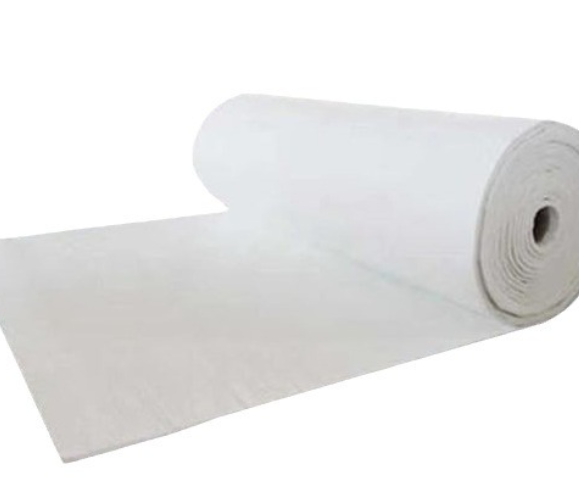
Surface reinforcement technology further enhances folding durability. Ultra-thin ceramic fiber paper surfaces are prone to fiber shedding from folding friction, compromising flexibility and lifespan. Breakthrough technology achieves surface protection through an “ultra-thin organic – inorganic composite coating” for surface protection: a 5-8μm-thick polyimide-silica composite coating is applied to the ceramic fiber paper surface. The polyimide provides excellent flexibility (20% elongation at break), while silica enhances coating adhesion to fibers, preventing peeling. The surface-treated ultra-thin ceramic fiber paper reduces its surface friction coefficient from 0.3 to 0.15 during folding, with a fiber shedding rate below 2% after repeated folding. The coating does not compromise the ceramic fiber paper’s fundamental properties: its breakdown voltage remains ≥18kV/mm, and thermal conductivity stays at 0.032W/(m·K), fully meeting insulation and thermal barrier requirements.
In practical applications, this breakthrough technology-enabled ultra-thin ceramic fiber paper demonstrates significant advantages: In flexible circuit boards, it withstands over 100,000 cycles of 0°-180° folding while maintaining stable insulation performance. In aerospace wire insulation applications, it tightly conforms to wire bends without cracking during long-term use. Furthermore, this technology allows parameter adjustments based on specific requirements—increasing the zirconia fiber ratio enhances high-temperature resistance, while optimizing the polyimide content in the coating improves flexibility, enabling customized production.
Overall, through synergistic innovation in fiber modification, molding process optimization, and surface reinforcement technology, ultra-thin ceramic fiber paper has completely overcome the limitations of poor folding flexibility inherent in traditional products. While retaining its core advantages in thermal insulation and electrical insulation, it now possesses the capability to adapt to flexible and dynamic scenarios, providing critical material support for miniaturization and flexibility in high-end manufacturing.