In high-temperature industrial applications, the dimensional stability of ceramic fiber blankets directly impacts the integrity and service life of thermal insulation structures, particularly in typical high-temperature environments of 1000°C. The patterns of dimensional changes under such conditions serve as a critical basis for material selection. Through systematic experiments and data analysis, the dimensional stability performance of ceramic fiber blankets in this temperature environment can be clearly understood.
Three common types of ceramic fiber blankets were selected for the experiment: standard type (1260°C), high-purity type (1400°C), and zirconia-containing type (1600°C). Samples of 200mm × 200mm were cut from each type, subjected to constant-temperature drying treatment, and then the initial length, width, and thickness were precisely measured as baseline data. The testing equipment used a box-type high-temperature furnace. The samples were placed in the central area of the furnace, heated at a rate of 5°C/min to 1000°C, maintained at a constant temperature for 100 hours, then allowed to cool naturally. The dimensional changes were measured again, and the shrinkage rate was calculated.
Test results indicate that different types of ceramic fiber blankets exhibit varying dimensional stability at 1000°C. The linear shrinkage rate of standard-type ceramic fiber blankets ranges from 2.1% to 2.5%, with thickness-direction shrinkage slightly greater than length and width directions; high-purity-type ceramic fiber blankets perform better, with linear shrinkage rates controlled between 1.2% and 1.5%; Zirconia-containing ceramic fiber blankets had the lowest shrinkage rate, ranging from 0.8% to 1.0%, demonstrating exceptional high-temperature dimensional stability. This difference stems from the varying fiber compositions; zirconia-containing ceramic fiber blankets, due to the addition of zirconia components, significantly enhance resistance to high-temperature shrinkage.
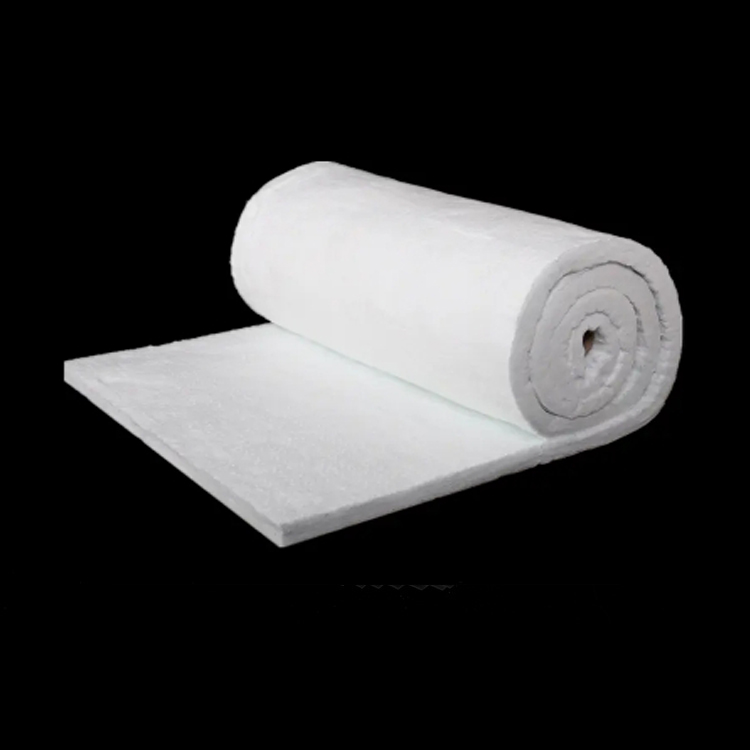
Microscopic structural analysis reveals the underlying mechanism of dimensional stability. Under high-temperature conditions, the crystal structure of ceramic fiber blankets undergoes slow rearrangement, but high-quality ceramic fiber blankets have stronger inter-fiber bonding strength, enabling them to resist structural shrinkage caused by crystal migration. Electron microscope observations show that after 1000°C high-temperature treatment, the fiber morphology of zirconia-containing ceramic fiber blankets remains intact with no obvious melting or adhesion, while standard-type ceramic fiber blankets exhibit localized shrinkage aggregation at fiber overlap points.
In practical applications, the dimensional stability of ceramic fiber blankets is critical. If the shrinkage rate exceeds 3%, it may cause gaps in the insulation layer, leading to heat loss and increased energy consumption. In industrial furnaces, high-temperature pipelines, and other equipment, using ceramic fiber blankets with low shrinkage rates can reduce structural loosening caused by dimensional changes and extend the maintenance cycle of the insulation system. Test data indicates that ceramic fiber blankets with shrinkage rates below 1.5% can maintain thermal insulation performance degradation rates below 5% after long-term use at 1000°C, significantly outperforming high-shrinkage products.
Overall, the dimensional stability of ceramic fiber blankets at 1000°C is closely related to their material type, with zirconia-containing and high-purity products capable of meeting the demands of stringent high-temperature environments. Understanding this characteristic provides a scientific basis for insulation design in high-temperature equipment, ensuring that ceramic fiber blankets maintain structural integrity and stable insulation performance during long-term high-temperature operation.