I. Raw Material Costs: The Starting Point for Quality Differences
Price variations in ceramic fibre paper stem from the choice of raw materials. High-quality products typically utilise a composite formulation of high-purity aluminium oxide fibres (Al₂O₃ content ≥45 per cent) and aluminium silicate fibres, with the addition of organic binders to enhance flexibility. The procurement cost of these raw materials is 30–50 per cent higher than that of ordinary fibres, but they enhance the product’s temperature resistance (up to 1,260 °C) and thermal shock resistance.
Low-end products, on the other hand, may utilise recycled fibres or low-purity raw materials; whilst the unit price is reduced by 20–40 per cent, this carries the following risks:
Uneven fibre diameter (>5 μm), leading to excessively high porosity
Excessive impurity content (Fe₂O₃ > 1.5 per cent), accelerating oxidation at high temperatures
Low volatilisation temperature of the binder (< 600 °C), affecting service life
II. Production Process: The Value of Precision Manufacturing
High-end ceramic fibre paper utilises a vacuum forming process, achieving performance breakthroughs through the following technologies:
Wet-forming technology: fibre dispersion uniformity of over 98 per cent
Hot-press shaping process: thickness tolerance controlled to within ±0.05 mm
Surface coating treatment: Forms a dense protective layer of 0.1–0.3 mm
Such processes require imported equipment (such as German VOITH paper machines) and strict environmental control (humidity ±2% RH, temperature ±1 °C), resulting in a single-line investment cost exceeding 20 million yuan. In contrast, ordinary products mostly utilise dry forming, with equipment investment of less than 5 million yuan; however, these products exhibit the following issues:
Low transverse tensile strength (<0.3 MPa)
High content of slag balls (>8 per cent)
Weak interlayer bonding (peel strength < 0.1 N/mm)
III. Performance Parameters: The Deciding Factor for Application Scenarios
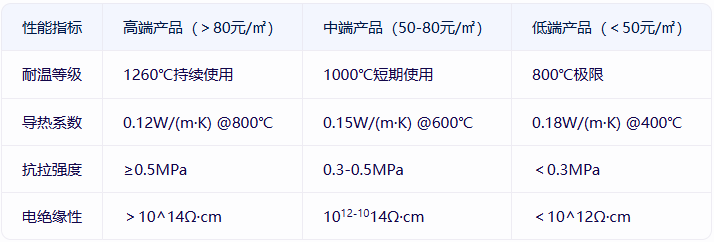
Comparison of typical application scenarios:
The aerospace sector (e.g. thermal insulation for rocket engines) requires the use of high-end products
Mid-range products are sufficient for industrial furnace linings
Low-end products may be used for general thermal insulation applications (e.g. domestic ovens)
IV. Brand Premium and After-Sales Service
International brands (such as Unifrax from the US and Morgan from the UK) are typically 20–30 per cent more expensive than high-end domestic products; their value lies in:
A comprehensive application database (covering over 3,000 operating condition parameters)
A 24-hour technical response mechanism
A product traceability system (each roll of paper has a unique QR code)
High-quality domestic manufacturers (such as the Nanjing Fibre Research Institute and Shandong Luyang) have, through technical expertise, managed to keep prices at 60–70 per cent of those of imported products, whilst also offering:
Customised thicknesses (0.5–6 mm)
Customised dimensions (widths up to 2,000 mm)
On-site installation guidance services
V. Purchase Decision Model
It is recommended to adopt the LCC (Life Cycle Cost) assessment method:
LCC = Initial purchase cost + Maintenance costs + Downtime losses – Residual value
Taking a high-temperature sealing retrofit project at a steelworks as an example:
Low-end solution: Unit price 40 yuan/m², replaced three times a year; total cost = 40 × 5,000 + 3 × 20,000 = 260,000 yuan
High-end solution: Unit price 90 yuan/m², replaced once a year; total cost = 90 × 5,000 + 1 × 5,000 = 455,000 yuan
Although the initial cost is 1.76 times higher, the high-end solution’s Life Cycle Cost (LCC) over five years is actually 18 per cent lower (after taking downtime losses into account).
VI. Industry Development Trends
With the revision of the GB/T 30075-2013 standard, the market in 2025 will present the following trends:
Tighter environmental requirements: Limit values for heavy metals such as lead and cadmium will be reduced by 50 per cent
Smart manufacturing: AI quality inspection systems will increase the first-pass yield from 85 per cent to 98 per cent
Functional integration: Graphene-modified products will achieve a thermal conductivity as low as 0.08 W/(m·K)
These trends are reshaping the pricing structure; by 2026, it is projected that:
Prices for basic products will fall by 15–20 per cent
The premium on functional products will increase by 30 per cent
Customised services will account for over 40 per cent of the market
Conclusion: Price variations in ceramic fibre paper essentially reflect a combination of materials science, manufacturing precision and application value. Selection should be based on specific operating conditions and quantified through a life-cycle cost (LCC) model, rather than a simple comparison of unit prices. For high-temperature equipment operating continuously, investing in high-end products often yields better economic returns; for non-critical components, mid-range products provide a balanced cost-effectiveness ratio.